Method in Policy Inquiries
Framework for Inquiry
The method of inquiry chosen for developing public policy can have a major effect on the recommendations that emerge. However, deliberate bias or sabotage is always possible. See below.
THEE identifies distinctive based on sharply differing views on how certainty can be assured when testing knowledge. This field, called epistemology by philosophers, has been extensively studied but …
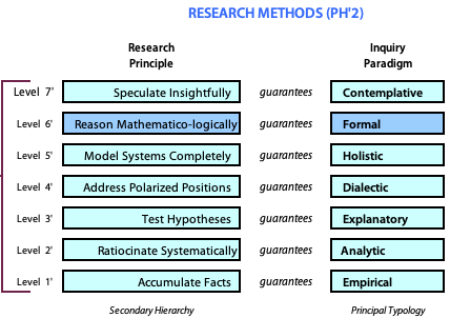
is a large and complex THEE-Topic with its own Satellite in the TOP web-cluster. Key aspects of inquiry are shown in this graphic:
Application to Sources of Policy
(CG-44)
These are concerned to be open and comprehensive, so they accept input of many sorts, and unselfconsciously seek to generate a account of the situation.
(CG-43)
Reports are offered as an analysis (). Most tend to organize facts as evidence (), sometimes applying statistical or other mathematical techniques (). Very few use , and the complex requirements of (controls, randomization, blindness &c.) are difficult if not impossible to implement in the societal sphere. Some policy analysts seek to identify dilemmas or reconcile opposing positions ().
(CG-42) &
(CG-41)
These usually draw on data and use and techniques. methods are usually viewed as too complicated. methods may be used to reconcile opposing positions of industry and advocacy groups.
Skewing the Results
Given immature political institutions, government will often commission papers to be written so as to recommend a course of action that has already been chosen on a political or self-interested basis.
Even when sabotage is not direct, recommendations are commonly slanted to the preferences of the funder. Sometimes details and mathematics are pseudo-science aiming to overwhelm or awe.
Because persuasiveness is given primacy in politics, understanding policy reports draws on the THEE Using Language-PH'5 framework rather than the framework.
- Consider the effect of mind-set on policy-generating inquiry.
Originally posted: August-2009; Last updated: 12-Jul-2012