Psychosocial Pressures on Depiction
Two Forms of Psychosocial Pressure
Every cell/entity in the Taxonomy is subject to psychosocial pressures. These pressures flow from the Domains (Levels) in the Root Hierarchy and explain similarities (resonance) between different taxonomic entities.
 More
More
Investigation in the Architecture Room led to the determination of pressures that apply to the various structures in the Taxonomy. The pattern of projection from the Root Hierarchy differs according to the destination structure: to Primary Hierarchies (& Tree levels), to Structural Hierarchies (& Tree levels), to Principal Typologies (& Spiral modes – Tree levels), and to Q-arenas.
These structural pressures determine the identity of the taxonomic entity. If we apply the Architecture Room findings to the Depiction Paradigms, the allocation of the Primary Psychosocial Pressure is as follows:
| L'7 |
Unitary |
Impose indivisibility |
Well-Being |
| L'6 |
Structural |
Determine order |
Selflessness |
| L'5 |
Unified |
Co-evolve with the context |
Acceptability |
| L'4 |
Dualistic |
Expect polarization |
Understanding |
| L'3 |
Causal |
Attribute cause |
Performance |
| L'2 |
Atomistic |
Respect boundaries |
Certainty |
| L'1 |
Dynamic |
Enable feedback |
Autonomy |
Subsequent studies have revealed something that should have been obvious: these taxonomic entities have to be operated. It turns out, perhaps not surprisingly, that this involves a different secondary psychosocial pressure.
The presence of secondary psychosocial pressures was discovered in studies of the Q-arenas in 2022, and then in 2025 the same phenomenon was discovered in a structural hierarchy. The patterning in both cases was identical although the 1° structural/identity pressure pattern in Q-arenas became the 2° operating pressure pattern in the structural hierarchy, and vice versa: a finding that is yet to be explained.
Each Paradigm will now be considered to confirm or justify the 1° structural pressure (which though given is again explored), and to develop the likely 2° operating pressure, which is still a mystery.
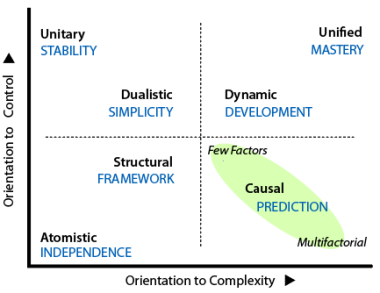
Application to Depiction
In determining these pressures, there is a need for focus.
-
The appropriate focus for the 1° structural pressure appears to be the ordering principle of the paradigm which forms the depiction and is the basis for its characteristic benefit.
-
The appropriate focus for the 2° operating pressure is the practical useof the paradigm, especially by a leader who selects and depends on the depiction and seeks to use it effectively.
L'1: Dynamic Paradigm
1° Structural pressure should be Autonomy based on previous taxonomic research.
But from first principles?
The ordering principle is ENABLE FEEDBACK. The depicter under the influence of Autonomy is driven to ensure that every member of the system is an independent source of feedback that can influence relations and activities. Basing depiction on feedback creates a system capable of adapting and evolving from within, so providing the characteristic benefit of development.
Alternatives: Performance may use feedback but it does not drive its free provision. Certainty would resist feedback. Understanding does not give feedback influence. Acceptability may suppress unwelcome feedback. Well-being is not appropriate. Selflessness does not specifically protect the right to give feedback and self-interest is to be expected.
2° Operating pressure appears to be Certainty.
Why?
The natural leader requests and responds to feedback as part of a concern for each member and the group as a whole. The diverse and changing views are resolved into a direction and definite choices that all can rely on. Depicting that is associated with this responsibility for both people and results gets driven by a pressure for certainty.
Alternatives: Performance could lead to exploitation or a ruthlessly rationality. Well-being and acceptability might seek to please and avoid necessary hard choices. Understanding does not drive anything definite. Selflessness could inhibit the necessary personal judgement. Autonomy functions as the 1° pressure.
L'2: Atomistic Paradigm
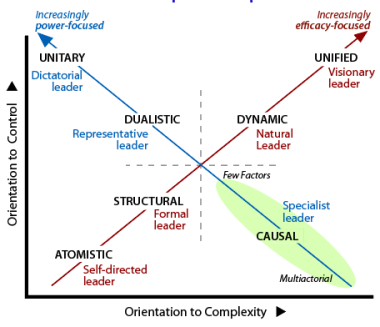
1° Structural pressure should be Certainty based on previous taxonomic research.
But from first principles?
The ordering principle is RESPECT BOUNDARIES. Each entity is given a definite boundary that distinguish and separates it from other entities. The boundary establishes a distinct identity, determines what belongs to the entity and locates relevant rights and duties that allow the characteristic benefit of independence. The pressure driving the depicter to make these boundaries unambiguous and dependable is therefore Certainty.
Alternatives: Performance does not determine boundaries. Acceptability and well-being do not define boundaries. Understanding does not remove ambiguity. Autonomy and selflessness do not specify or guarantee boundaries.
2° Operating pressure appears to be Performance
Why?
Self-directed leaders focus on their own identity, rights and sphere of responsibility, choosing independently to pursue its own advantage so as to survive and thrive, while leaving others free to do likewise. Accomplishments are what count and that means the pressure is for Performance.
Alternatives: Autonomy and understanding are taken for granted, do not maintain independence and need not lead to accomplishments. Acceptability could compromise independence. Well-Being could favour dependence but is not focused on accomplishment. Selflessness would be counter-productive. Certainty functions as the 1° pressure.
L'3: Causal Paradigm
1°Structural pressure should be Performance based on previous taxonomic research.
But from first principles?
The ordering principle is ATTRIBUTE CAUSE. From amongst a multiplicity of possibilities, cause is attributed to particular factors. It is asserted that the cause has a particular effect and so provides the basis for prediction. A pressure for Performance drives the depicter to make causal attributions that yield successful predictions.
Alternatives: Certainty might drive definitive attribution but not predictive success. Acceptability would drive consensus not predictability. Well-Being could just be reassuring. Understanding produces explanations but does not guarantee prediction. Autonomy and selflessness are irrelevant to predictive success.
2° Operating pressure appears to be Understanding.
Why?
Specialist leaders use causal depiction by considering potential causal attributions in the light of a deep expertise and long experience of such situations. Each case presents different factors, relationships and uncertainties whose implications the specialist seeks to grasp before asserting a cause. Understanding is what drives this functioning.
Alternatives: Certainty could harden a misleading attribution. Well-Being could lead to avoidance of the issue. Acceptability does not govern useful or expert attribution. Autonomy does not assist with attribution or prediction. Selflessness is not relevant when attributing causes. Performance functions as the 1° pressure.
L'4: Dualistic Paradigm
1° Structural pressure should be Understanding based on previous taxonomic research.
But from first principles?
The ordering principle is EXPECT POLARIZATION. The depicter divides the variety within a situation into two opposing sides, forces or categories, which makes the situation intelligible at the cost of generating tensions and conflicts. Because everything can then be interpreted by reference to one side or the other, the characteristic benefit of simplicity emerges. While simplification makes the situation readily understandable, those using other paradigms are liable to view the opposition as distorting, biassed or erroneous. The pressure driving the depicter to produce this easy-to-grasp opposition is therefore Understanding.
Alternatives: Performance is irrelevant. Certainty does not reduce the variety. Acceptability, well-being, autonomy and selflessness do not demand dichotomization.
2° Operating pressure appears to be Acceptability.
Why?
The representative leader is driven to use a dualistic paradigm to create a consensus that unites a large group to which they belong in direct opposition to the goals of some countervailing group. In handling this polarized situation, the leader must assume or develop choices, positions and compromises that the group will accept. This means the paradigm is operated under a pressure for Acceptability.
Alternatives: Performance does not create group agreement. Certainty will not persuade a group. Well-being does not confer a mandate. Autonomy could separate the leader from their group. Selflessness does not win group support. Understanding functions as the 1° pressure.
L'5: Unified Paradigm
1° Structural pressure should be Acceptability based on previous taxonomic research.
But from first principles?
The ordering principle is CO-EVOLVE WITH CONTEXT. The depicter includes the interacting component-systems and their environment within a single evolving whole. A concern for the depiction to resonate with all drives continuing accommodation of diverse perspectives and changing circumstances. This all-inclusive, context-sensitive depiction provides the characteristic benefit of mastery. The pressure driving the depicter is therefore Acceptability.
Alternatives: Performance does not govern co-evolution. Well-Being is not relevant for inclusive depicting. Certainty and understanding do not drive an evolving complexity. Autonomy will not drive co-evolution. Selflessness is not essential for co-evolution.
2° Operating pressure appears to be Selflessness.
Why?
The visionary leader is driven to use a unified paradigm to serve the evolution of the whole including its context. In developing and pursuing the vision which will be offered as a truth, all personal preferences, ambitions and sectional interests must be set aside. Becoming a vehicle for such an awareness entails a pressure for Selflessness.
Alternatives: Performance does not lead to a vision. Certainty and well-being are not intrinsic to complex co-evolution. Understanding is insufficient for holistic awareness. Autonomy would be counter-productive as a driver. Acceptability functions as the 1° pressure.
L'6: Structural Paradigm
1° Structural pressure should be Selflessness based on previous taxonomic research.
But from first principles?
The ordering principle is DETERMINE ORDER. The depicter assigns every component of a system a place or role and specifies the relationships, flows and rules that enable consistent functioning. The order generates a framework with a distinct identity. Creating the framework entails dispassionately setting aide personal preferences and special interests to determine an order that endures as people, choices and contexts change. The pressure driving specification is therefore Selflessness.
Alternatives: Performance, certainty, well-being and acceptability all seem inappropriate or irrelevant for generating a viable impersonal framework. Understanding is necessary to use the framework but does not determine its definition. Autonomy could create distortions based on self-interest.
2° Operating pressure appears to be Well-Being.
Why?
The formal leader or other depicter seeks to create a framework for others to function securely and effectively, which means performing and cooperating. If everyone involved feels good about the framework and can operate in a satisfying and safe fashion, then they are likely to ensure everything functions as required. So well-being is the pressure that drives creation of the framework .
Alternatives: Performance focuses on results not any particular order or its effect on users. Certainty about functioning is not possible. Acceptability is relevant but not dominant because functioning is crucial. Understanding may inform the design but does not produce the order. Autonomy could put the depicter's interests before the interests of the participants. Selflessness functions as the 1° pressure.
L'7: Unitary Paradigm
1° Structural pressure should be Well-Being based on previous taxonomic research.
But from first principles?
The ordering principle is IMPOSE INDIVISIBILITY. The depicter presents the entity as an undifferentiated whole and denies internal differentiation. In this way, internal conflict based on differences are excluded. This minimizes disruption and unwanted change, providing the characteristic benefit of stability. The pressure driving the depicter to create homogeneity is therefore Well-Being.
Alternatives: None of the other pressures—performance, certainty, acceptability, understanding, autonomy, selflessness—inherently demands indivisibility.
2° Operating pressure appears to be Autonomy.
Why?
The dictatorial leaderis driven to depict in this way because it presents the entity as an extension of the leader's self and will. No component has a legitimate independent existence and so dissent and individuality can be suppressed. Anyone and anything that casts doubts, seeks change or challenges the leader is immediately identified and crushed. Such a depiction is driven by an intense Autonomy.
Alternatives: Performance, certainty, acceptability, understanding and selflessness do not govern the imposition and preservation of indivisibility. Well-being functions as the 1° pressure.
Overview
The pattern defined above is shown in the Table below.
| L'7 |
Unitary |
Well-Being |
Autonomy |
| L'6 |
Structural |
Selflessness |
Well-being |
| L'5 |
Unified |
Acceptability |
Selflessness |
| L'4 |
Dualistic |
Understanding |
Acceptability |
| L'3 |
Causal |
Performance |
Understanding |
| L'2 |
Atomistic |
Certainty |
Performance |
| L'1 |
Dynamic |
Autonomy |
Certainty |
Patterning is evident: the 2° pressure at one level becomes the 1° pressure at the next level up—a process that is more evident in a colour-coded arrangement as shown below:
| 1°: Identity |
Autonomy |
Certainty |
Performance |
Understanding |
Acceptability |
Selflessness |
Well-Being |
| 2°: Operation |
Certainty |
Performance |
Understanding |
Acceptability |
Selflessness |
Well-Being |
Autonomy |
This patterning fits the generative progression that is found in the unfolding duality. In structural hierarchies the 2° pressure at one level also becomes the 1° pressure at the next level up, and there is some commonality in pressures as well.
Originally posted: 20-Apr-2025. Last amended: 8-Aug-2026.