Review
Each of the 7 methods for using language reflect a positive initiative of a communicator. However, the audience or recipient may re-interpret the communication in terms of their own habitual method. e.g. a conceptual thinker may hear terms and give them meanings according to definitions that the speaker is not using. An associative speaker may hear conceptual terms and give them associations that are wildly inappropriate.
Using language effectively is a natural concern and responsibility of each person: even if few reflect on that fact. However, it is also a natural concern of your immediate contacts and wider society. Miscommunication or inappropriate communications can cause distress and social turmoil. Appropriate communications foster group goals and enable broader social needs to be met.
The TET analysis is essential to understand language in its daily use.
TET Analysis
The tables below provide a reminder of the properties used to plot the TET.
| Method | Effect | Corresponds with |
Generation of Meaning | Example | |
|---|---|---|---|---|---|
| L'7 | Mythic
|
Enabling transcendence. | Openness-L7 | Submit to a potent image of a situation even if fully outside present understanding. | Greek myths. |
| L'6 | Logical
|
Determining essences. | Meaning-L6 | Systematize unique identifiers for unique things so meaning is universally unequivocal. | Mathematical foundations. |
| L'5 | Gestalt | Generating experiential truth. | Terms-L5 | Express the human condition via imaginative use of unrelated terms. | Shakespeare's plays. |
| L'4 | Universal
|
Catching interest quickly. | Symbols-L4 | Make verbal and non-verbal choices in accord with popular conventions on usage. | Daily newspapers. |
| L'3 | Conceptual | Developing a field of study. | Signs-L3 | Get agreement on definitions of necessary concepts that signify a field. | Exchanges in academic disciplines. |
| L'2 | Associative | Enjoying familiarity. | Signals-L2 | Enable a subjective flow of mental links (verbal and non-verbal) that are immediately understood in the group. | Everyday conversation amongst friends. |
| L'1 | Concrete | Specifying useful procedures. | Stimuli-L1 | Point to or illustrate things directly corresponding to elements of the message. | Instructions for assembling flat-pack furniture. |
| Method | Practical Function | Group Aspect | Personal Aspect | Reality Aspect | |
|---|---|---|---|---|---|
| L'7 | Mythic | To provide stories about existence, good & evil. | Galvanizes a group to form a united front. | Activates spiritual energies. | Fosters transcendence of mundane reality. |
| L'6 | Logical | To identify useful assumptions. | Overcomes irrelevancy and emotionality in debates. | Enables proper handling of situations. | Specifies fundamentals as essences or principles. |
| L'5 | Gestalt | To reveal the multi-faceted human significance of a topic. | Elevates group consciousness. | Evokes deep human experiences by resonance. | Represents complex personal or social issues as a whole. |
| L'4 | Universal | To allow ideas wide dissemination and influence. | Ensures commonality by sharing values and emotions. | Enables communica- tions amongst all in a specific society. | Affirms received reality and opposes alien ideas. |
| L'3 | Conceptual | To investigate and explain the unknown. | Enables a body of disciplined thinkers. | Maintains acuity of thought and exposition. | Develops and establishes knowledge in a field. |
| L'2 | Associative | To make immediate personal observations. | Uses familiarity and sustains social contact | Asserts self in terms of actions and relations. | Enables use of subjectivity in a specific situation. |
| L'1 | Concrete | To specify processes in the finest practically relevant detail. | Provides for uniform or synchronized actions. | Provides routine, ritual and self-discipline. | Covers the detailed inner workings of things |
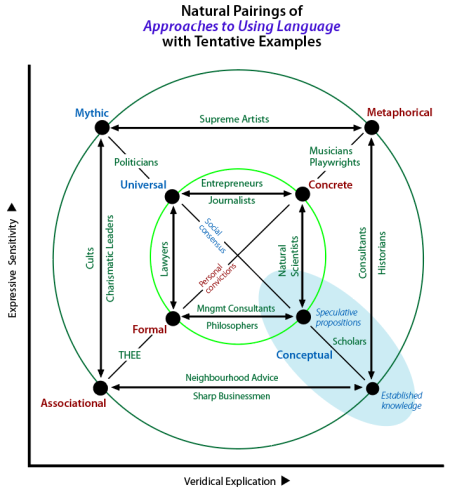
Group survival is what communication is about. The stability and growth of any enduring group or society depends on a flow of communications and the use of language. Sustaining the shared psychosocial reality within the group depends on (a) consensus around key ideas, values and issues related to survival and progress, and (b) conviction as to the validity and relevance of those ideas and values.
In the TET analysis, it was evident that consensus within a group is developed by approaches on the diagonal running from lower R to upper L. Convictions are individual and are developed by approaches on the diagonal running from lower L to upper R.
The world is overwhelmingly complex and certainty is impossible in psychosocial matters. So convictions, right or wrong, complement the current consensus or foresee a desired one.
Everyone can both use and understand every approach to some degree. However, under social pressures of various sorts, individuals tend to adhere to a particular quadrant, diagonal or bi-arrowed line as required by the nature of their endeavours and their reference group.
In the diagram, the lines reveal a concern for a similar level of care in expression (horizontal links) or a similar effort to make sense (vertical links).
Further Applications of the TET Analysis
Because communication is so fundamental to social life and because the way language is used has such powerful effects, it is possible to identify some applications.
- ► Benefits of familiarization with the methods: personal and societal.
- ► How to handle truth in society, especially if painful.
- ► How religion uses language.
Originally posted: 15-Oct-2014. Amended: 4-Sep-2016. Last updated: 28-May-2026.