Applying Styles to the Domain Typologies

PH'1Q: 28 Levels in the Arenas of Achieving
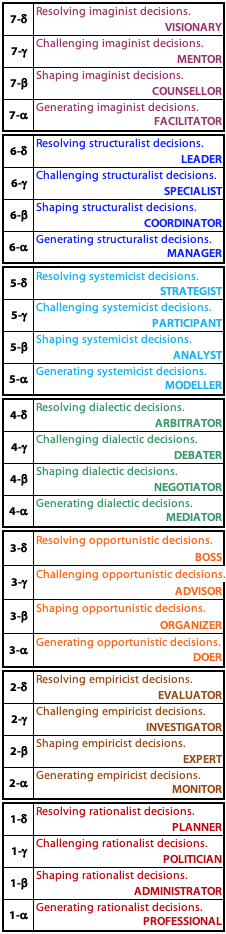
28 levels in the Decision typology.

Review a summary of Decision Methods-PH'1here.

Recall the Style Hierarchy developed in the preceding Topic:

L PH'1
δ Resolving
γ Challenging
β Shaping
α Generating

Now, by applying this Style Hierarchy to each of the Decision Methods, it has been possible to provide labels that characterize recognizable achieving roles. Note that there may well be other possible labels.

L'1: ClosedRationalist Method

α: Professionals generate rationalist decisions

β: Administrators shape those decisions

γ: Politicians challenge their administrators

δ: Planners resolve the choice via their forward-looking comprehensive view.

L'2: ClosedEmpiricist Method

α: Monitors generate empiricist decisions

β: Experts shape those decisions

γ: Investigators challenge the experts

δ: Evaluators resolve the choice via their impartial analytical view.

L'3: ClosedPragmatic Method

α: Doers generate opportunistic decisions

β: Organizers shape those decisions

γ: Advisors challenge the organizers

δ: Bosses resolve the choice via their dogmatic powerful view.

L'4: ClosedDialectic Method

α: Mediators generate dialectic decisions

β: Negotiators shape those decisions

γ: Debaters challenge the negotiators

δ: Arbitrators resolve the choice via their unbiased and definitive view.

L'5: ClosedSystemicist Method

α: Modelers generate systemicist decisions

β: Consultants shape those decisions

γ: Participants challenge the consultants

δ: Strategists resolve the choice via their balanced future-oriented view.

L'6: ClosedStructuralist Method

α: Managers generate structuralist decisions

β: Coordinators shape those decisions

γ: Subordinates challenge the coordinators

δ: Leaders resolve via their dynamic value-driven view.

L'7: ClosedImaginist Method

α: Facilitators generate imaginist decisions

β: Counselors shape those decisions

γ: Mentors challenge the counselors.

δ: Visionaries resolve via their energetic and inspiring view.

PH'2Q: 28 Levels in the Arenas of Knowing

28 levels in the Research typology

Review a summary of Research Methods-PH'2here.

Recall the Style Hierarchy developed in the preceding Topic:

L PH'2
δ Anchoring
γ Evaluating
β Organizing
α Grounding

Now, by applying this Style Hierarchy to each of the Research Methods, it has been possible to provide labels that characterize recognizable knowing roles. Note that there may well be other possible labels.

L'1: ClosedEmpirical Method

α: Data Collectors ground empirical research

β: Investigators organize that research

γ: Statisticians evaluate research findings

δ: Meta-analysts anchor the significance of multiple empirical findings via conclusions.

L'2: ClosedAnalytic Method

α: Researchers ground analytic research

β: Analysts organize that research

γ: Critics evaluate analytic conclusions

δ: Integrators anchor the significance of multiple analyses.

L'3: ClosedExplanatory Method

α: Hypothesizors ground explanatory research

β: Experimenters organize that research

γ: Competitors evaluate falsifications

δ: Theorists anchor the significance of multiple tests via unification.

L'4: ClosedDialectic Method

α: Polarizers ground dialectic research

β: Adherents organize polarized positions

γ: Debaters evaluate both sides

δ: Synthesizers anchor the significance of polarization via resolution.

L'5: ClosedHolistic Method

α: Structuralists ground holistic research

β: Modelers organize that research

γ: Users evaluate the model

δ: Designers anchor the significance of models via application.

L'6: ClosedFormal Method

α: Questioners ground formal research

β: Logicians organize that research

γ: Verifiers evaluate the logical arguments

δ: ?? anchor the significance of the theorem via ??

L'7: ClosedContemplative Method

α: Commentators ground contemplative research

β: Genius's organize contemplative inquiry

γ: Sceptics evaluate the new paradigm

δ: Doyens anchor the significance of the new paradigm via their acceptance.

PH'4: 28 Levels in the Arenas of Individualizing
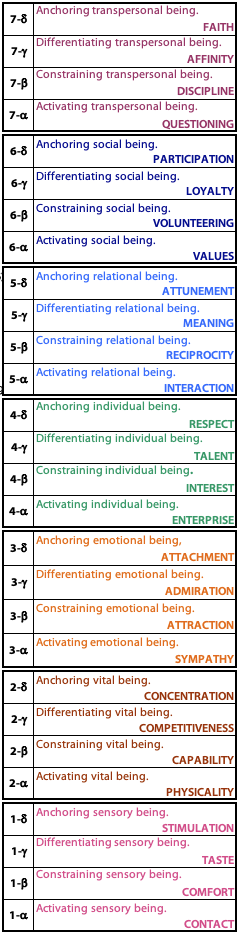
28 levels in the Mental Stabilization typology.

Review a summary of Mental Stabilization Methods-PH'4here.

Recall the Style Hierarchy developed in the preceding Topic:

L PH'4
δ Anchoring
γ Differentiating
β Constraining
α Activating

In the previous two Domains, applying the Style Hierarchy has generated role-types. Possibly starting in Change-PH'3, but certainly in Experience-PH'4, it seems that distinctive psychological states emerge rather than social roles. It has been possible to provide labels that characterize recognizable individualizing states.

 Labels proposed here are less certain.

L'1: ClosedSensory Method

α: Contact activates sensory existence

β: Comfort constrains the degree of activation

γ: Taste differentiates the form of contact

δ: Stimulation anchors the mental state.

L'2: ClosedVital Method

α: Physicality activates vital existence

β: Capability constrains the degree of activation

γ: Competitiveness differentiates the form of physicality

δ: Concentration anchors the mental state.

L'3: ClosedEmotional Method

α: Sympathy activates emotional existence

β: Attraction constrains the degree of activation

γ: Admiration differentiates the form of sympathy

δ: Attachment anchors the mental state.

L'4: ClosedIndividual Method

α: Enterprise activates individual existence

β: Interest constrains the degree of activation

γ: Talent differentiates the form of enterprise

δ: Respect anchors the mental state.

L'5: ClosedRelational Method

α: Interaction activates relational existence

β: Reciprocity constrains the degree of activation

γ: Meaning differentiates the form of interaction

δ: Attunement anchors the mental state.

L'6: ClosedSocial Method

α: Values activate social existence

β: Strength constrains the degree of activation

γ: Loyalty differentiates the form of values

δ: Participation anchors the mental state.

L'7: ClosedTranspersonal Method

α: Questioning activates transpersonal existence

β: Discipline constrains the degree of activation

γ: Affinity differentiates the form of questioning

δ: Faith anchors the mental state.

PH'5: 28 Levels in the Arenas of Associating
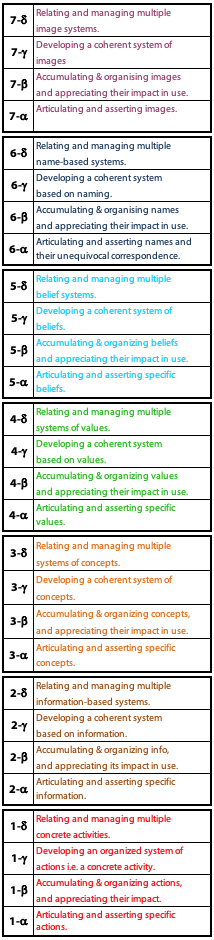
28 levels in the Use of Language typology

Review a summary of Language Use Methods-PH'5here.

Recall the Style Hierarchy developed in the preceding Topic:

L PH'5
δ Developing
γ Systematizing
β Appraising
α Asserting

Unlike the Domains listed above, applying this Style Hierarchy appears to generates distinctive processes rather than roles or states. It should be possible to provide labels that characterize recognizable associating processes.

L'1: ClosedConcrete Method

α: Caring asserts association via activity

β: Coping appraises situations via helpful actions

γ: Individuating systematizes preferred activities

δ: Maturing develops the range of possible activities.

L'2: ClosedAssociative Method

α: Specifying asserts association via available information

β: Responding appraises situations on the basis of information

γ: Methods systematize the use of information

δ: Programs develop a range of situations

L'3: ClosedConceptual Method

α: Reviewing asserts association via concepts

β: Methods appraise projects on the basis of concepts

γ: Designing systematizes preferred concepts

δ: Programming develops the range of projects

L'4: ClosedUniversal Method

α: Interests asserts association via shared values

β: Solutions appraise the use of values

γ: Issues systematize the handling of values

δ: Narratives develop the state of values.

L'5: ClosedGestalt Method

α: Realizing asserts association via awareness

β: Mentoring appraises the degree of awareness

γ: Disseminating systematizes the form of awareness

δ: Bonding develops the form of awareness.

L'6: ClosedLogical Method

α: Meditating asserts association via correspondence with reality

β: Contemplating appraises the degree of correspondence

γ: Practicing systematizes the application of correspondence

δ: Reflecting develops the quality of correspondence.

L'7: ClosedMythic Method

α: Conceiving asserts association via images

β: Exploring appraises the impact of images

γ: Involving systematizes the form of questioning

δ: Commissioning develops the quality of images.

PH'6: 28 Levels in the Arenas of Governing
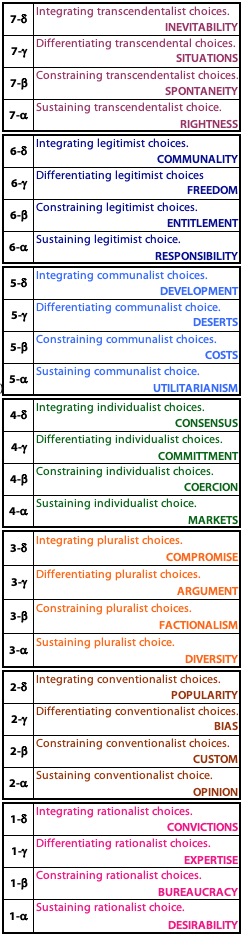
28 levels in the ethical choice typology.

Review a summary of Ethical Choice Methods-PH'6here.

Recall the Style Hierarchy developed in the preceding Topic:

L PH'6
δ Anchoring
γ Contesting
β Constraining
α Grounding

By applying this Style Hierarchy to each of the Ethical Choice Methods, it seems possible to provide labels that characterize recognizable governing rationales.

L'1: ClosedRationalist Method

α: Desirability grounds rationalist choices

β: Bureaucracy constrains implementation

γ: Expertise contests amongst alternatives

δ: Convictions anchor the choice that is made.

L'2: ClosedConventionalist Method

α: Opinion grounds conventionalist choices

β: Custom constrains implementation

γ: Bias contests amongst alternatives

δ: Popularity anchors the choice that is made

L'3: ClosedPluralist (Pragmatist) Method

α: Diversity grounds pluralist choices

β: Factionalism constrains implementation

γ: Argument contests amongst alternatives

δ: Compromise anchors the choice that is made

L'4: ClosedIndividualist Method

α: Markets ground individualist choices

β: Coercion constrains implementation

γ: Commitment contests amongst alternatives

δ: Consensus anchors the choice that is made.

L'5: ClosedCommunalist Method

α: Utilitarianism grounds communalist choices

β: Costs constrain implementation

γ: Deserts contest amongst alternatives

δ: Development anchors the choice that is made.

L'6: ClosedLegitimist Method

α: Responsibility grounds legitimist choices

β: Entitlement constrains implementation

γ: Freedom contests amongst alternatives

δ: Communality anchors the choice that is made.

L'7: ClosedTranscendentalist Method

α: Rightness grounds transcendentalist choices

β: Spontaneity constrains implementation

γ: Circumstaniality contests amongst alternatives

δ: Destiny anchors the choice that is made.

Review

From the above, it seems that the Q-expansion may have different effects according to the Domain. Light may be shed when PH'3Q and PH'7Q Arenas are determined.

  1. PH'1 & PH'2: generation of roles.
  2. PH'4 & PH'5: generation of states or processes.
  3. PH'6: generation of rationales.

The next step in this investigation involves determining some principles for identifying the Arenas which straddle two adjacent Methods.

Originally published: 24-Sep-2022