Signification v Generation
Thesis + Antithesis = Synthesis
All Principal Typologies are thought to have an unfolding duality i.e. an intrinsic tension between:
- a ground state that is basic and unavoidable when the Type is operative; &
- a developmental force offering potential for that state to be improved or refined.
For the , this duality is proposed as follows:
A signification emerges directly when language is used and this is therefore the ground state of the method.
Additional meaning can be generated with effort. So generation is the developmental force for each method that extends the scope of the communication.
The signification-ground is the form that the language method must take, while the generation-force is an operation on those forms.
This duality applies only to the . The does not use language but deals with the language that is provided.
 THEE theory
In , signification is proposed as the ground state and generation as the developmental force.
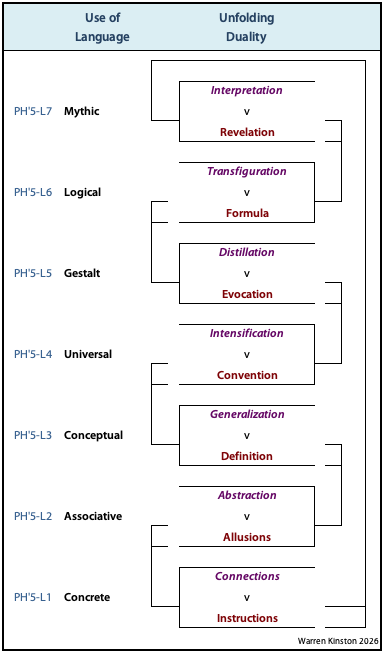
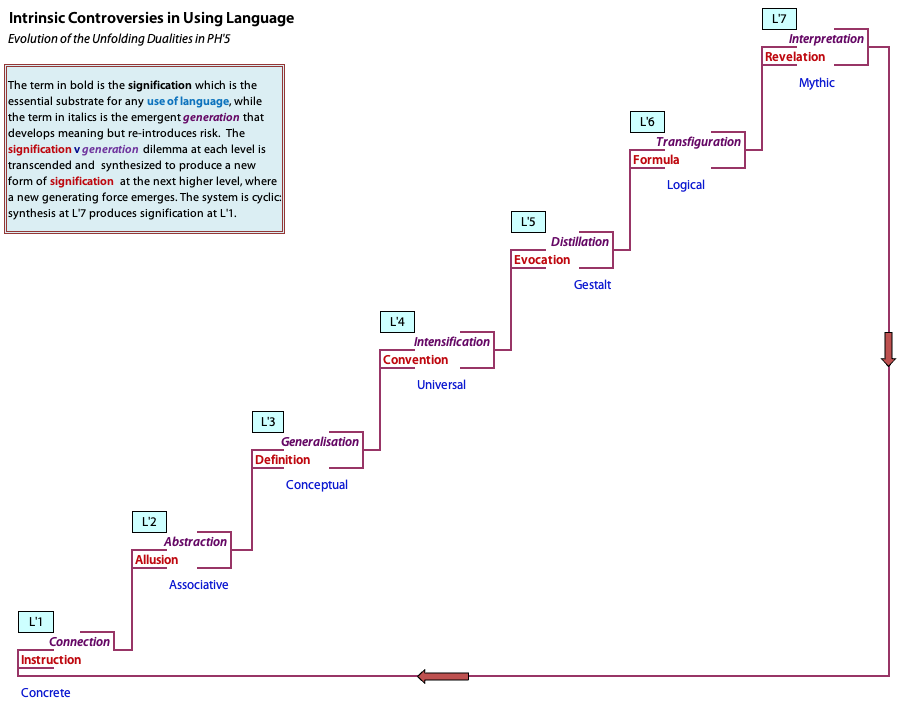
The unfolding duality manifests in a different form within each Type (Level), with the generating pole propelling movement to the next higher Type: i.e. the dilemma at each Level is resolved by synthesis to create a new form of signification at the next higher Level. This in turn activates a new form of generation.
The system is cyclic because the duality at is resolved by the form of signification at .
The Seven Dualities
L'1: Concrete
Instruction v Connection
The communicates using instructions based in words and/or pictures that are designed for general use. The signification here is explicit (nothing essential omitted), sparse (nothing unnecessary included), and ordered so that there is no uncertainty about what to do.
However, the difficulty with this practical signification thesis is that it excludes the idiosyncratic thinking and background of the recipient, reasons that are meaningful in practice, and contextual factors affecting use of the instructions. The antithesis is therefore the provision of specific connections for a particular recipient.
Synthesis: The tension between general instructions and particular connections meaningful for individual recipients can be relieved by using allusions—which is the thesis at the next level up.
L'2: Associative
Allusion v Abstraction
The communicates using allusions which lead to conversations that feel natural, easy and comfortable. But such signification can only operate within an in-group constantly sharing activities, experiences and context.
The difficulty with this signification thesis is that the language is indirect, opaque, obscure and confusing for outsiders. The antithesis is therefore abstraction from the in-group particularity to produce an unambiguous explicit meaning.
Synthesis: The tension between allusions and abstractions can be relieved by providing agreed-upon definitions—which is the thesis at the next level up.
L'3: Conceptual
Definition v Generalization
The communicates using definitions: key words are given an agreed explicit meaning within a delimited field. This signification permits coherent, consistent and cumulative development of the field.
The difficulty with this scholarly signification thesis is that it generates a jargon which is only comprehensible to those trained and immersed in the specialist field. The antithesis is generalization that allows the meaning to become part of the language used in wider society.
Synthesis: The tension between definitions and generalizations can be relieved by communication using widely agreed conventions—which is the thesis at the next level up.
L'4: Universal
Convention v Intensification
The communicates using conventions: everyone comes to tacitly share phrases, images and references so that everyone feels they understand what is being said or written.
The difficulty with using conventions is that they are superficial and only seem true because so many details are ignored. To reach beyond the convention thesis, the communicator must penetrate what is merely plausible and intensify the focus on the issue. So the antithesis is intensification.
Synthesis: The tension between conventions and intensification can be relieved by ensuring an evocation that directly reveals the experiential truth of the situation—which is the thesis at the next level up.
L'5: Gestalt
Evocation v Distillation
The communicates using evocation. Signification here depends on imaginatively combining words, images, sounds, and other stimuli so that the recipient senses the truth of the situation.
The use of ambiguity, paradox and other techniques calls for talent in the communicator and a willing sophisticated receptivity. The evocation (thesis) is complex, reaching deep but unable to be applied broadly to many situations. To be extended, it is necessary to distil the account to articulate a felt truth that is believed to be at its core. So the antithesis is distillation.
Synthesis: The tension between evocation and distillationcan be relieved by developing a formula that reaches a universal fundamental applicable to all such situations—which is the thesis at the next level up.
L'6: Logical
Formula v Transfiguration
The communicates using formulae that are concise, precise and veridical. Formulae capture an essence, a universal fundamental, that is available to anyone who is prepared to observe and reflect. Formulae do not depend on social agreement or specialized training.
The difficulty with formulae as the signification thesis is that they are impersonal and do not provide guidance in negotiating reality. Formulae lack power to command or transform or align a person with a transcendental Absolute Reality. To get formulae to do more, they must be transfigured in some fashion. So the antithesis is transfiguration.
Synthesis: The tension between formulae and transfiguration can be relieved by providing revelations—which is the thesis at the next level up.
L'7: Mythic
Revelation v Interpretation
The communicates using revelations that are counter-intuitive or mysterious, spiritual and often seem magical.
A revelation is a signification thesis that demands personal alignment or re-alignment. However, the revelation, being cryptic, cannot easily be acted upon. Interpretation of the revelation construes the transcendent message into something graspable. Because it renders a revelation into an actionable and followable form, it serves as the antithesis.
Synthesis: The tension between revelation and interpretation can be relieved by conversion into instructions about what to do—which is the signification thesis of the original .
As usual, the unfolding duality is cyclical.
- Back to Review.
- Continue with handling reality.
Originally posted: 4-Sep-2016. Last updated: 16-Jul-2026.