Developing the Typology Essences Table
Note: This is a general account applicable to all Typologies.
Principal Typologies are found within the 6th Level of a Primary Hierarchy: see THEE Path. Each is a set of 7 methods that govern how that Hierarchy is operated. In practice, they appear as approaches or mentalities which attract commitment and belief within a particular domain of functioning.
The Types can be plotted on a 2x2 table, called a Typology Essences Table (TET). The resulting TET layout reveals features of practical importance that would otherwise be difficult to notice.
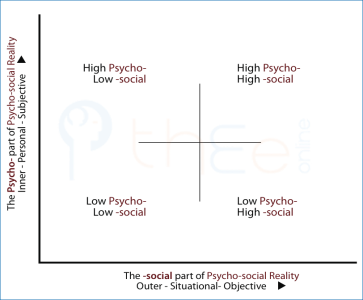
Each TET requires names for its axes. These names define the executing duality (eD) of the Types.
-
One executing dimension relates to the essence of the desired output (outcome or result) when using any .
By convention, it is the X-axis. The X-axis is always outer, social, environmental, situational or objective: i.e. the X-axis is the «-social» aspect of psycho-social reality.
-
The other executing dimension relates to a focus on the personal means or requirement to produce the relevant output.
By convention, it is the Y-axis. The Y-axis can be categorized variously as inner, personal, mental, psychological or subjective: i.e. the Y-axis is the «psycho-»(logical) aspect of psycho-social reality.
Once we have the correct formulations of the in the Typology and have identified the appropriate executing duality, then each of the 7 can be assessed and compared as: «very high» or «high» — covering the higher part of each axis; or «low» or «very low» — covering the lower part of each axis.
The inquiry challenge is to name the TET axes validly and sufficiently precisely for the focus of concern.
 Getting it Right
-
With this explanation in mind, continue to define the axes.
Originally posted: 10-Oct-2014. Last updated: 16-Dec-2014.