Forms in the Primary Hierarchy
PH7
Willingness
refers to sustenance of a positive disposition towards the actualization of an endeavour. That means willingness comes into its own and becomes most visible when processes related to an endeavour are deeply problematic and likely to be avoided.
Willingness is driven by the psychosocial pressure of selflessness. At the same time, it flows from taking 100% responsibility for your choices and your life.
We normally think of willingness as part of an endeavour, where it functions as an obvious and shareable state. We notice it in others and others notice it in us. Willingness can be contagious, off-putting or fail to generate any effect.
Like (and unlike other Levels of Will), exists on a continuum. We can be more or less willing, or more or less reluctant. This property should be noticeable in all emanated forms within the Willingness Domain, and it is.
Whatever degree of positivity and energy is present, willingness retains intrinsic properties as a function of the self: it can be genuine, authentic, sincere, forthright and sometimes courageous. It can also be false, artificial, insincere, wishy-washy and lead to avoidance.
Seven Forms
What is Willingness at L1?
The L1 form of willingness is driven by a performance pressure and involves the Action Domain.
 Click for an Intuitive but Incorrect Form
Willingness must be applied in situations where, left to yourself, you would not take action and neither internal nor external pressures for performance would activate you. From a purely egotistic perspective, you view the situation calling for action as too difficult or too complicated. It is beyond what you believe that you can achieve, and the sensible thing is to retreat or give up.
While many challenges are best avoided, it is often a borderline call. You may misjudge what you are capable of and you may see difficulties that are unlikely to eventuate. Often others believe that you can do it, while every fibre in your body resists their urging.
All you can do in such borderline situations is . In many borderline situations, others expect you to make an attempt even if it doesn't work out. In Australian culture, "having a go" is a trait that wins admiration every time.
is the L1 manifestation of Willingness in the field of Action.
And you do not try just once, you can be expected to —persistence is important.
Function: refers to making a specific effort even though failure is evidently possible or even likely.
Formal Object: A course of action i.e. you try to do something over time.
Alternate name: Attempting. In everyday language,
Colloquial: give it your best shot, have a crack at it, give it a go, make a stab, go for it, make an effort, do your best.
What is Willingness at L2?
The L2 form of willingness is driven by a certainty pressure and involves the Inquiry Domain.
Click for a Natural but Incorrect Way of Thinking
Willingness must be applied when a particular view is affirmed strongly even if it is intrinsically uncertain or even metaphysical, or when knowing something is unpopular or vehemently rejected by peers.
Views where everyone is certain and all evidence is supportive can also be affirmed in exactly the same way. Scientific knowledge, for example, is determined by consensus and often turns out to be incorrect. So believing a scientific view is either blind conformity or a deliberate act of willingness.
In 1896, William James wrote an essay, "The Will to Believe" in which he argues that in specific non-rational or undetermined situations (and he was thinking of religion), it can be permissible and even pragmatically necessary to adopt a belief as a willful choice.
can operate in reverse too. As well as that you choose to adopt, you also need willingness to , your own and those widely held by others.
Many issues and situations do not lend themselves to certainty and yet a belief appears to be required to act confidently and effectively. A belief is not something to be adopted lightly, it must be if it is to be credible and used in practice.
Some hold firmly to the view that maintaining a sceptical stance in which nothing is believed is a way out of this dilemma—but this is a self-contradiction because it is evident that «not holding beliefs» is a willingly adopted belief.
Function: refers to adhering to a view and applying it even if doubtful, contested, unproven or untestable.
Formal Object: Mental contents: commonly views, ideas, or something that can be known by inquiring.
Alternate name: Assuming: but assuming can be a pragmatic choice and developed on the spot; so it is less satisffactory.
What is Willingness at L3?
The L3 form of willingness is driven by an acceptability pressure and involves the Change Domain. Where acceptability exists, there is no need for specific willingness in regard to making or accommodating changes.
However, willingness must be applied if change is appropriate but personally unacceptable. This becomes evident when the ego-driven reaction to a situation is to withdraw, to self-isolate, or to go along with a communal denial of some issue that needs handling.
Change is about seeing clearly how things actually are and what must be done to make the reality more acceptable personally and/or socially. A refusal to see, a form of denial or psychic blindness, can descend if the remedy seems costly or unpleasant or if it seems safer to join with others who deny any need for change.
is the L3 manifestation of Willingness in regard to actualities. is about upholding . Against inner opposition, you must consent to face something. This is accepting the unacceptable by acknowledging that ignoring an unwanted reality will likely lead to some harm. Facing is never a momentary consent but an active process that must be maintained until the harsh reality is dealt with or naturally resolves.
Function: refers to addressing a relevant reality directly irrespective of its uncongeniality or urges to conform to a common denial of its significance or existence.
Formal Object: An account of reality or relevant facts.
Alternate name: Seeing. But:
What is Willingness at L4?
The L4 form of willingness is driven by a well-being pressure and involves the Experience Domain. Where there is a state of well-being, there is no need for specific willingness to enable experiences and support individuality.
However, willingness must be applied if you are to remain in a situation where there are ongoing frustrations, unpleasantness, disagreements, forced conformity, and decisions you dislike. That sounds like the reality that characterizes much of social life.
While there is much about sociality that is enjoyable and comforting, no group revolves around any single individual with his or her unique needs and preferences. There is always a degree of social friction. As a result your self-interest often pushes you to withdraw, turn away, become isolated, drag-your-heels, and possibly disrupt the group by behaving as an outsider. This applies even more so in fluid, temporary or fragmented social settings. A selfless willingness becomes necessary if you are to belong under difficult conditions.
is the L4 manifestation of Willingness that emerges in relation to social life. Participation here means becoming part of a group or situation. This generates which must be in a good spirit. So the requirement is to and that entails submitting to the inevitable discomforts that any group or situation generates without losing heart, and not just momentarily for show but in a way.
Function: refers to gladly belonging to a social situation or group despite its intrinsic frustrations, demands and inconveniences.
Formal Object: A social context or setting like an informal or formal group.
Alternate names: Joining (in), Partnering, but neither of these terms seems so generally applicable.
What is Willingness at L5?
The L5 form of willingness is driven by an understanding pressure and involves the Communication Domain. Where sufficient understanding exists, there is no need for specific willingness to enable communication that powers cooperative activities.
However, willingness must be applied when associating and pursuing some social activity while sensing that an understanding of what is going on is lacking, weak or faulty. If the social choice or other person or the situation feels alien, wrong or incomprehensible, but you push on nevertheless, then you are taking a risk.
Without this willingness to risk, your self-interest would push you to draw back, hesitate, or opt out. You would claim ignorance, deplore the lack of a common ground and express an over-riding aversion to loss combined with a desire for safety and self-protection.
is the L5 manifestation of Willingness that emerges in relation to undertakings where a shared reality needs to be fully understood but where it is evident that many things must remain unclear, uncertain and unpredictable. The requirement is to and then as the undertaking unfolds. Of course, daring to take this step only occurs because you assume or at least hope that some tangible benefit will result or some harm or greater risk will be avoided.
Function: refers to entering an undertaking for gain despite the potential for significant harm or loss.
Formal Object: Personal resources, tangible and intangible.
Alternate name: Chancing: but this implies reliance on luck.
What is Willingness at L6?
The L6 form of willingness is driven by an autonomy pressure and involves the Purpose Domain. Where autonomy is operative and unproblematic, there is no need for specific additional willingness to enable the expression of values and goals.
Autonomy and self-interest go together. But the nature of willingness is that it operates selflessly and over-rides self-interest for some greater good. Over-riding autonomy generates a situation where you refuse to be an agent, where you assume someone or something outside yourself should act on you or control your choices. That means a situation where you regard dependency and even helplessness as an appropriate psychosocial position.
Having a need to learn is just such a situation. Learning is surely an acquisition of knowledge and a change in your outlook that shows in observable behaviour—but it is much more than that. Learning is a profound and powerful process in which you use your autonomy to abandon your autonomy. You accept that you are facing a particular challenge and you do not have a necessary ability or knowledge to deal with it. Because you lack expertise, you will fail if left to yourself. You realize that to get the needed guidance, you must become dependent on a source outside yourself and beyond your control. Alternatively, you resolve to proceed and likely fail but still benefit by learning from that experience.
is the L6 manifestation of Willingness that emerges as an unforced elective choice to accept dependency as you . The alternative wilful or arrogant approach denies the need to learn by avoiding the challenge. Such a stultifying and self-limiting attitude is usually viewed as immature and irresponsible. An equally foolish alternative is to press on to a likely failure while projecting blame and denying any fault or limitation on your own part.
Learning is episodic. Its significance for personal growth means that willingness calls for all to , recognizing that learning episodes never cease. It is noteworthy that while "continuing education" had its roots in the 19thC, the notion only became popularized in the 1970's.
Function: refers to acquiring additional knowledge and skills despite the effort required, the uncertain relevance, and the likelihood of errors.
Formal Object: Required ability like knowledge or skills.
Alternate name: Schooling, but this suggests a structured formal system and is therefore too narrow.
What is Willingness at L7?
The L7 form of willingness is driven by a selflessness pressure and involves the Willingness Domain. Where selflessness is naturally applicable, there is no need for a specific willingness to enable submission and service for others.
Selflessness refers to responding to the needs and nature of the other or the whole rather than being concerned for your own self-interest. Willingness will therefore be required in situations where you sense your own vulnerability and have an urge for self-protection in relating.
In emerging situations like a new relationship, pure selflessness would lead you to deny your own self-boundaries and fuse with that person and situation in an almost fatalistic and possibly dangerous way. What you require is that the situation with the persons involved should configure itself to serve you, to protect you, and to generate benefit for you. But will it?
is the L7 manifestation of Willingness that emerges as a way to handle any new and unknown relationship or situation in a positive way by presuming the existence of goodness in the other and the situation generally. Willingness is not an issue where you have come to trust a person or situation through many interactions over a long period. The emphasis here is on a new situation where you need to .
It is evident that the notion of "believing in" is closer to (than to ) because there is no reason for the entity (e.g. God) or person (e.g. a new relationship) or theory (e.g. psychoanalysis) to configure itself for your benefit and you have no control. Even if the best policy on entering most situations is to trust (and adjust as events evolve), the requirement to can feel fraught and demands psychological effort.
Function: refers to opening up your self to a new unknown relationship or situation without any guarantee of benefit or protection from harm.
Formal Object: Presupposed goodness.
Alternate name: None known.
Importance of Time
An intrinsic feature of forms of willingness is that they are potentially difficult to activate due to egotistic concerns. These egotistic forces don't just accept defeat but return quickly to encourage giving up.
Persistence is therefore important and is a criterion of meaningful functioning in this Domain.Details:
Tabulation
| L# | Form of Willingness | Function | Formal Object | Commencement & Persistence |
|---|---|---|---|---|
| 7 | Trust |
To open up your self to a new unknown relationship or situation without any guarantee of benefit or protection from harm. | Presupposed goodness | Grant trust & Develop trust |
| 6 | Learn |
To acquire additional knowledge and skills despite the effort required, the uncertain relevance, and the likelihood of error or failure. | Required ability | Pursue learning & Value learning |
| 5 | Risk | To enter an undertaking for gain despite the potential for significant harm or loss. | Personal resources | Take the risk & Tolerate the risk |
| 4 | Participate |
To gladly belong to a group or social situation despite its intrinsic frustrations, demands and inconveniences | Social context | Welcome participation & Sustain participation |
| 3 | Face |
To address a relevant reality directly irrespective of its uncongeniality or urges to conform to a common denial of its significance or existence. | Account of reality | Consent to face & Continue facing |
| 2 | Believe |
To adhere to and apply a view even if doubtful, contested, unproven or untestable | Mental contents | Adopt a belief & Maintain a belief |
| 1 | Try | To make a specific effort even though failure is evidently possible or even likely. | Course of action | Start trying & Keep trying |
Completeness
The taxonomic postulate here is that this set of ways that willingness manifests in psychosocial reality is complete and limited to 7 elements.
In looking at the literature such as it is, we do often see "willingness to learn", "willingness to risk", "willingness to participate"—all appearing in the above set. The prevalent academic terminology of "willingness to X" can be explained in two ways:
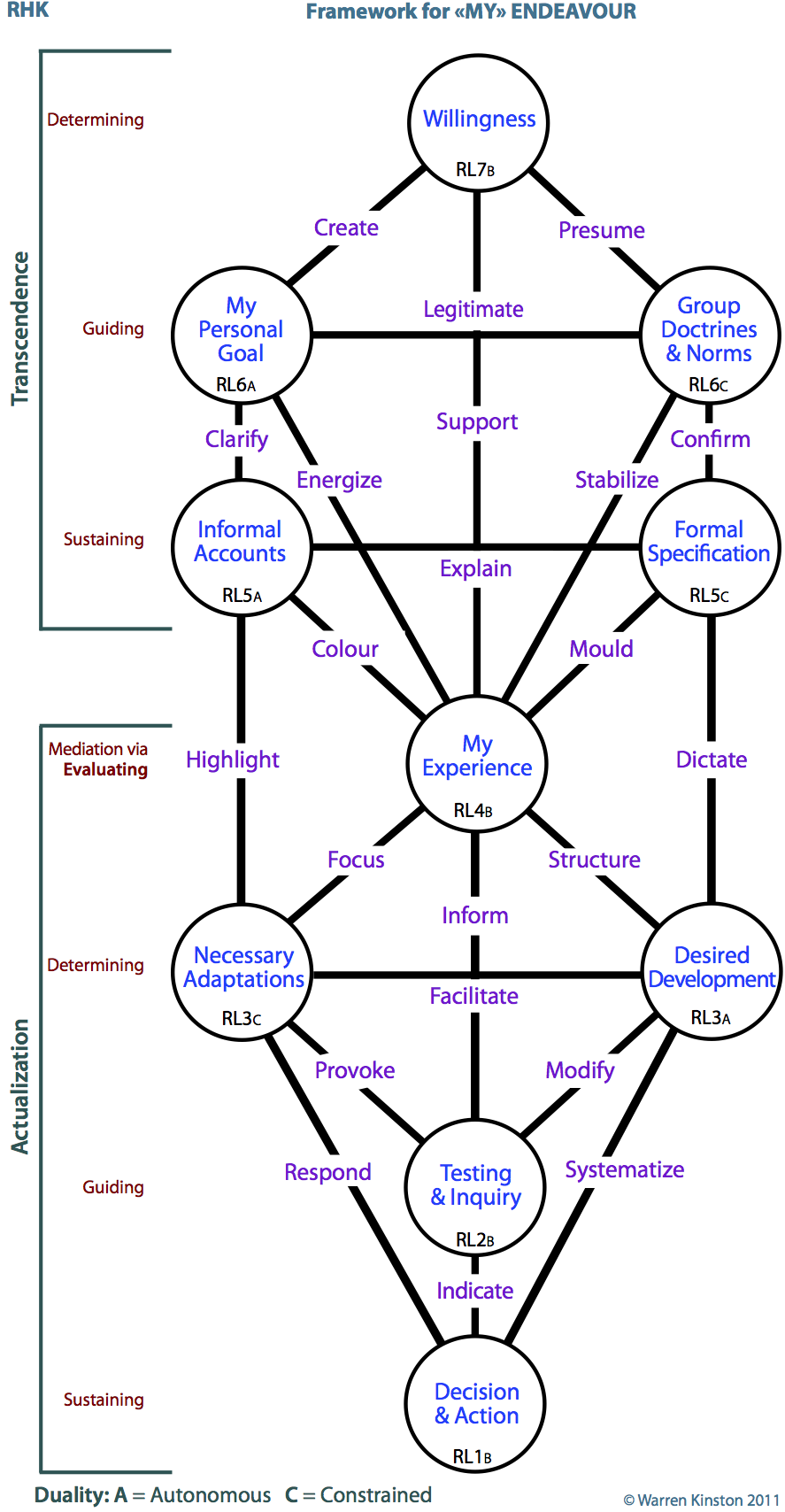
(a) it treats learning, risking, or participating as part of an endeavour, and emphasizes the role of , focusing perhaps on channels to personal and . Click thumbnail to view.
(b) it is an abstract or tautologous formulation, because it is not possible in practice to learn or risk or participate without being willing.
In looking at the literature on willingness, it is useful to distinguish:
the formal object (i.e. the defining, intrinsic or essential object)
from
the issue of concern.
Many willingness studies focus on issues of concern, for example, "willingness to pay", "willingness to suffer consequences", "willingness to accept responsibility", "willingness to exercise"?
EITHER this use of willingness refers to specific endeavours as in (a) above;
OR these are examples of formal objects or combinations of these objects.
For example:
• "Willingness to pay" or "willingness to gamble" could be an example of if the formal object is personal resources, or perhaps if the formal object is presupposed goodness.
• "Willingness to accept responsibility" or "suffer consequences" could be examples of if the formal object is an account of reality, and/or if the formal object is a course of action; and/or if the formal object is personal resources.
This is an area where empirical research would be useful.
Taxonomic thinking has enabled conjectures for the forms and functions that takes at each level of a presumed hierarchy. Now it is necessary to check that the nature and ordering of those forms fit formal features of THEE-type Primary Hierarchies.
As an initial step, it will be useful to flesh out some intrinsic properties to distinguish the forms/levels.
- Properties of the elements of .
Originally posted: 3-May-2026. Amended: 27-Jun-2026.