What is a Structural Hierarchy?
Features
An account has been provided in the Hub,
Structural hierarchies are the mid-point of a triplet: originating from a 7-level Tree and generating a final 7-level Tree.
Each Level in the a structural hierarchy is a Grouping that contains all Levels of the originating hierarchy, which in this case is the and its Tree .
Each Grouping contains Groups that are willingness complexes with distinctive functions that may be activated when required.
The final Tree () is formed from the Groupings specified as Requirements.
More Technical Details
Structural Hierarchies are developed by progressively grouping adjacent Levels of THEE’s 7-Level holistic hierarchies in all possible ways. «Holistic» means that Levels in the hierarchy broadly imply or include each other, and this applies here.
The first «Level» in a Structural Hierarchy is a Grouping of 1 Level i.e. Grouping-1 () contains 7 Groups that are Monads i.e. made up of 1 original Level. The next «Level» will contain all Groups of 2 adjacent Levels i.e. contains 6 Dyads…and so on until we reach , the Heptad Grouping where there is just one Group consisting of all 7 original Levels.
As a result, every G-Level contains all the Levels of the originating hierarchy i.e. the original differentiation of an entity into Levels has been replaced by a re-unification applicable at each G-Level. There are 28 Groups (components) in a Structural Hierarchy.
However, definition of this THEE form is far more complex. Internal Levels i.e. the Levels within any Group, have distinctive qualifiers, which give the function of that level an essential characteristic. The qualifier applicable to a particular level finds its nature originating in the Level (or Monad) where it first appears e.g. the Monadic qualifier is created by Level-1 (or G11); the Dyadic qualifier is created by Level-2 (or G12), and so on. Internal levels that carry the qualifier are labelled with a lower case 'g' e.g. g4 refers to the 4th Level in each of the Tetrads, Pentads, Hexads and the Heptad and always has the same qualifier. Note that g4 does not exist in the Monads, Dyads or Triads which have fewer than 4 internal Levels.
Layout of a Structural Hierarchy
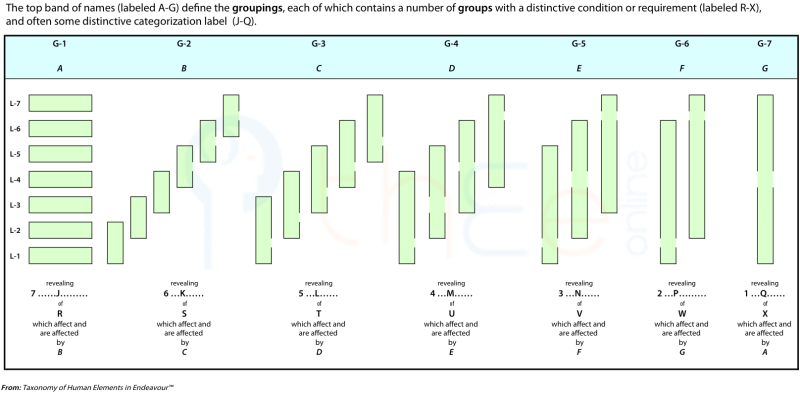
The two noteworthy features here are the Requirements labeled A-G above the Groups. Below are the States, labeled R-X below the Groups.
Each Group directly affects and is affected by the next Group in the series, with the system being cyclic in that G7 leads to G1.
Continue to:
- Hope in human survival
- Preview of the findings taken Grouping by Grouping.
- Check how energies enable serving.
- Start with the 7 vehicles of faith: G1-Monads.
Originally posted: 30-Jun-2026.