Vehicles of Faith: G1-Monads
‘Hope’ is the thing with feathers –
That perches in the soul –
And sings the tune without the words –
And never stops – at all –
Emily Dickinson, 1891
Instilling Hope
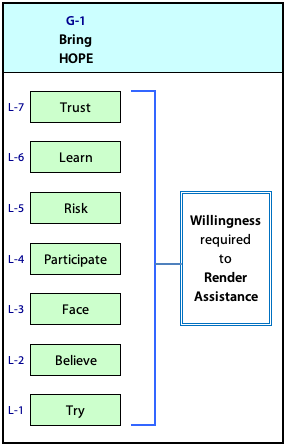
The elements of have certain functions and properties when looked at purely through the lens of willingness. These original properties remain relevant.
However, the present context is different. The lens has changed from «» generally to becoming involved specifically to «». Suddenly, these willingness elements become about instilling hope, and this suggests their labelling as .
To instil hope in yourself or another, you must recognize that even the smallest amount of positivity can kick-start benefits. There is faith not only that this hope will be justified, but also faith in oneself so that others, all too aware of the difficulty of the challenge, are encouraged.
In a structural hierarchy, the grouping of 1 level generates 7 monads. As a taxonomic principle, monads require a qualifier that fits with . Confidently is provisionally proposed as the g1-qualifier, meaning displaying a positivity that counters any negativity and indicates there will be no holding back.
Note: This assignation means that all 28 components of this structural hierarchy necessarily include a bottom g1 level and need to be grounded in confidence.
The function of is proposed as: to activate in a person a readiness to engage with whatever challenges present.
Requirements: Hope must generate both energy and confidence to make the effort. Without energy, nothing is possible and without a degree of confidence, nothing will happen. All vehicles of faith benefit from encouragement and can be disrupted by discouragement flowing internally from moods and dysphoric emotions.
Dysfunction presents here as a defeatist attitude, leading to a half-heartedness which does not raise hopes much if at all.
Destructiveness appears here as despair or hopelessness which prevents activation of any of the monads. Hopelessness can be a precursor to death, especially when combined with helplessness.
Vehicles of Faith
G11: Try
Here, faith is applied to a course of action
Function in instilling hope: To demonstrate that an effort is being made.
, though often daunting, can be activated by encouragement, while discouragement can decrease willingness.
Willingness weakens if there is a temptation to give up easily.
Destructiveness: that takes the form of bluffing or faking effort.
G12: Believe
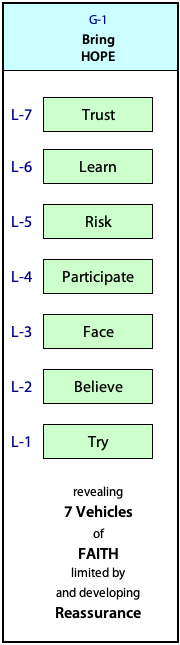
Here, faith is applied to knowing.
Function in instilling hope: To provide a rationale for expecting efforts to help.
can resist challenge by drawing on evidence or testimonials, as well as personal past experience. Self-belief is usually essential.
Willingness weakens if there is a wavering in the use of crucial beliefs.
Destructiveness: that is hypocritical, so that presented beliefs are a pretence or even contrary to actual beliefs.
G13: Face
Here, faith is applied to an account of a situation.
Function in instilling hope: To directly acknowledge all relevant factors in a situation.
up to facts can be best enabled via honest dialogue with a trusted associate. Sometimes providing more evidence or using persuasive techniques helps.
Willingness weakens if conformity to "what everyone knows" dominates and distorts awareness.
Destructiveness: that is deliberately deceptive and dishonest.
G14: Participate
Here, faith is applied to the social setting.
Function in instilling hope: To join and cooperate with others who are involved.
can be assisted by active recognition and inclusion, as well as honest dialogue, evidence and encouragement.
Willingness weakens if there are conflicts of interest.
Destructiveness: that is aloof and disconnected.
G15: Risk
Here, faith is applied to personal wishes.
Function in instilling hope: To identify a beneficial outcome while accepting the possibility of harm or loss.
fears of loss can be reduced by provisions for mitigation, as well as active recognition, honest dialogue and comparison with alternatives.
Willingness weakens if loss aversion dominates.
Destructiveness: that is reckless.
G16: Learn
Here, faith is applied to remedying gaps in ability.
Function in instilling hope: To acquire relevant knowledge and understanding.
makes demands and, if these feel overwhelming, access to mentors, public resources, and dedicated tools can help.
Willingness weakens if a person is suspicious of the motives of teachers and public resources.
Destructiveness: Arrogance prevents because it prevents acknowledgement of any deficiency and denies that others could have superior expertise.
G17: Trust
Here, faith is applied to the use of willingness.
Function in instilling hope: To assume all will go well and there will be no harm.
can be assisted by proofs of trustworthiness and fostering reflection on defensiveness.
Willingness weakens if prior experiences of hurtful betrayal remain emotionally present.
Destructiveness: that is submerged by paranoid ideation and conspiracy theories.
 See Table Summary for Easier Comparison
Psychosocial Pressures
Studies in the Architecture Room have determined a standard pattern for pressures in the groupings of structural hierarchies. These studies determined 1° pressures that are structural or identity-based.
The identified 1° pressure for G1 is autonomy. This applies here because the person must embody hope and, to be genuine, that depends on acting autonomously.
Recent studies in a structural hierarchy identified the presence of a 2° pressure related to operating groups within any grouping. The pressure driving use of the various G1-groups here——should be understanding if it follows the standard pattern.
On reflection, that would fit because you cannot even begin to attempt the impossible by activating these states if you do not understand what is going on and what you are getting yourself into.
Transition
has been raised—but will it be dashed? Is the imagined help going to develop into something more, or will it just fizzle out? After the feel-good rush around bringing hope, will the obstacles seem just too great or the effort just too hard?
Those are the concerns of everyone connected to the situation including yourself.
Everyone involved requires reassurance that there will be follow-through and that can be provided by indicating your determination. Signs of determination are sought and can be expected to support and increase hope. Conversely, hesitancy, indecisiveness and vacillation will be disappointing and disheartening.
It turns out that it is possible to activate by adding an adjacent level to form dyads that .
-
The 6 promises of continuity: G2-Dyads.
Originally posted: 30-Jun-2026.