Means of Proceeding: G3-Triads
Maintain Intentions
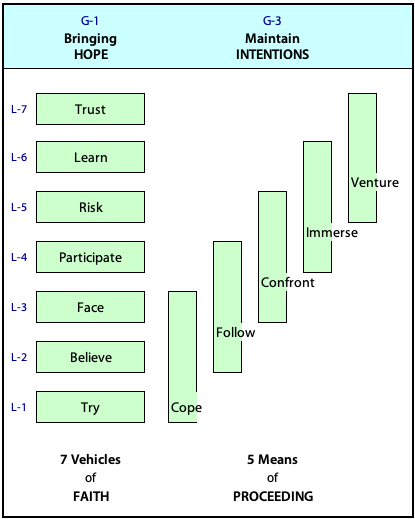
Once is established, the next requirement to is to maintain intentions that govern the effort and its emergent plans.
Plans never last the course, and so it is essential to make adjustments to keep the process on track.
The willingness to do this appears to be enabled by groups that contain an additional level. This leads to formation of 5 triads. Each triad has a qualifier that emerges from . This is provisionally proposed to be «explicitly» in the sense of being open, clear and aware of essential features of the situation.
The triad as a whole must be explicit, and the highest level specifically requires the g3-explicit quality. The middle level must be g2-unequivocal, and the lowest level must be g1-confident.
calls on distinct which are as follows:
The function of the triads is proposed as: to overcome obstacles while maintaining direction and momentum.
The triads reveal a progression upwards from the mundane, immediate and unavoidable through to the more imaginative occasional and optional.
Given that explicit is the qualifier, dysfunction shows up as a loss of focus and activities that drift away from the relevant goals.
Destructiveness at shows up as sabotage of the attempt to render assistance by ignoring the relevant required intentions and substituting undesired or inappropriate goals.
Properties: All the means involve entangling yourself in a problematic situation. ARE THERE SPECIFIC PROPERTIES?
Oscillating Pattern?
The potential for a pattern emerges from the contrast noted between G1-monads and g2-dyads.
are a matter of personal assertion directed outwards to generate in others.
By contrast, are directed inwards to oneself but dependent on approval from others confirming the receipt of
The contrast suggests that might resemble . On examination: do appear to be expressions of personal intention and responsibility. So use of is a matter of personal assertion directed outwards to enable —confirming a likely oscillating pattern.
 Schema for Presentation
Function: as basis for taxonomic identification.
Challenge in maintaining intentions and so proceeding.
Structure of the triad into three levels.
Stance in rising to the challenge.
Prevalence and necessity for use.
Time Horizon in proceeding.
Failure effect when a means of proceeding is needed.
Means of Proceeding
Cope-G31
Function: To deal with a situation calmly despite its many demands.
When rendering assistance, the situation is never easy. If it were, then assistance would likely not be needed. Often those in receipt of the aid create difficulties through seemingly unreasonable entreaties.
In most cases, situations evolve in unpredictable ways, often triggered by the presence of aid. Typically there are intrusions, distractions, obstacles and resistances. Whatever happens, the situation must be dealt with in a calm methodical way.
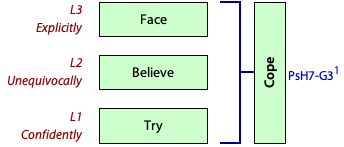
is based in:
L1: because it is about doing, and confidence enables calmness.
L2: because.....
L3: the actual and ever-changing reality of the situation.
Stance: Reactive.
Prevalence: Invariable and unavoidable, coping is obligatory and generally applicable.
Time Horizon: Coping is immediate and exists in a continuous present.
Failure: If coping fails, then there is a collapse in the endeavour and the likelihood of abandonment of assistance.
Follow-G32
Function: To stay aligned with given directions despite personal reservations.
Given directions, whether from a leader or based in a group consensus, may seem incoherent, inconsistent, debatable, misguided or contrary to your own judgement. The group itself may be uncertain or wavering in its endorsement.
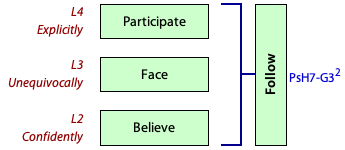
is based in:
L2: in the value of the directions, because otherwise reservations will undermine your participation.
L3: the realities because
L4: which is why the directions that are given by the group or a leader within it cannot be ignored. Defiance would entail stopping participating and, depending on the seriousness, probably result in exclusion.
Stance: Receptive.
Prevalence: Ubiquitous. Everyone, even the leader, is also expected to be a follower. Rather than being an expression of willingness, following is often more like a habit of subordination.
Time Horizon: Following is also exists in a continuous present. However, it may be needed only for a pre-defined or limited period.
Failure: If following ceases, this is defiance or disobedience. If widespread, then the group is liable to fall into disarray. Following persists if there is defection or rebellion—just transferred to an alternative leadership.
Confront-G33
Function: To highlight uncomfortable realities despite social resistance and potential hostility.
Confrontation is often awkward or uncomfortable. It may be unconventional in the group, affect vested interests, embarrass members or leaders, present as a threat, appear as arrogance, and ruffle feathers in the hierarchy. The possibility of being ignored, rejected or discredited is high.
is based in:
L3: a reality in which many or most in the group are ignoring something crucial like a danger, a failure, a mistake, a loss, an opportunity.
L4: in the group and its future. If this was not so important, taking the chance of confronting would not occur.
L5: your position and reputation in the group because of the hoped for benefit that will accrue if what has been ignored or avoided is taken seriously and addressed.
Stance: Assertive.
Prevalence: Less common because of tendencies in groups to avoid conflict, seek consensus and value conformity.
Time Horizon: Confronting occurs episodically. It happens at a specific moment, either because the time is felt to be right or because an issue has come to light and any delay in recognizing it is too risky.
Failure: Seeing the need for confrontation and refusing to speak up is a form of submission or a capitulation to groupthink.
Immerse-G34
Function: To absorb oneself in a challenge despite costs and uncertainty of success.
In many situations, there is a block to progress that resists conventional comprehension from the outside. In order to proceed, there must be a deliberate immersion in the situation or its block to allow understanding imaginatively from the inside.
Immersion takes attention, time and energy away from the obvious needs and immediate practicalities seen by others. It is difficult to assess in advance whether immersion will generate valuable insights.
is based in:
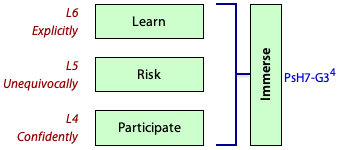
L4: in the situation and possibly with individuals associated with the the block.
L5: your time, your energies, your balance, the support and perhaps even the respect of others.
L6: what you need to know to overcome the specific block that precipitated this approach.
Stance: Creative.
Prevalence: Optional and selective, with this path depending on personal preferences as well as the particular role adopted or assigned.
Time Horizon: Extended for as long as required..
Failure: If immersion is required, then avoidance or failure leads to misdirection or a superficial form of proceeding that will not succeed.
Venture-G35
Function: To embark on an unfamiliar endeavour despite its unknown requirements and consequences.
Entering the unknown involves learning from experience while facing dangers that cannot be wholly predicted or mitigated in advance.
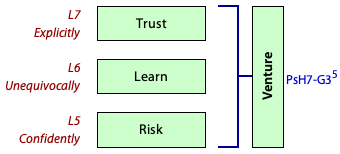
is based in:
L5: because it is obvious that any unfamiliar initiative will expose you to hazards that cannot be wholly predicted or mitigated in advance, and yet confidence is essential or venturing will be avoided.
L6: occurs as you reflect on your progress along new paths and into new arenas. You will also be forced to develop new knowledge and skills to handle surprises and dangers encountered along the way.
L7: your instincts and your imagination as well your colleagues on this new initiative.
Stance: Reflective.
Prevalence: Exceptional and highly individualized.
Time Horizon: Variable: the endeavour may be time-limited or open-ended.
Failure: Venturing fails if it is unrealistic or there is a lack of necessary forethought.
See Table Summary for Easier Comparison
Psychosocial Pressures
Studies in the Architecture Room have determined a standard pattern for pressures in the groupings of structural hierarchies. These studies determined what are now called 1° structural or identity pressures.
The identified 1° structural pressure for G3 is performance.This applies here because the person can be expected to experience a pressure to adhere to and deliver on those intentions.
More recent studies in a structural hierarchy identified the presence of a 2° operating pressure by focusing on the groups within any grouping. The pressure driving use of the various G3-groups here——should be certainty if it follows the standard pattern.
On reflection, that would fit because the are all demanding and not spontaneously appealing. No-one is likely to adopt any unless they have a degree of certainty about their usefulness in rendering assistance. Outsiders too will request certainty before approving or supporting the various means.
Transition
has been implemented, but often, especially in difficult situations, demands escalate from multiple sides. Emotional pressure is often brought to bear. Wishes that accompany intentions to help can lead a person into uncharted choppy waters.
If balance is lost, rendering assistance becomes difficult or gets disrupted. The solution here is not to withdraw or avoid, but to honestly address the relationships that are at the root of pressures and difficulties.
It turns out that it is possible to take deliberate steps to by adding an additional adjacent level to form tetrads. They reveal powerful ways to —if the willingness is there.
-
The 4 preservers of relationships: G4-Tetrads.
Originally posted: 20-May-2026.