Preservers of Relationship: G4-Tetrads
Retain Balance
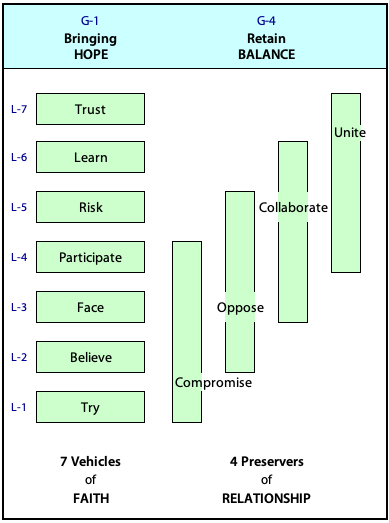
Only after come to the fore, does the possibility arise of losing balance. Influences from situational needs and desires of those involved interact with your own personal tendencies and needs. The result can easily be destabilizing. Any choices made to readjust your handling of the situation brings relationships into focus.
When becomes a priority, the most important requirement is to . This can be enabled by combining an additional level to form 4 tetrads. Each tetrad has a new qualifier that emerges from . This is provisionally proposed as «reliable» in the sense of being someone whose presence and contribution can be counted on.
This means that each tetrad that preserves relationships must have g1-confident , g2-unequivocal, g3-explicit and g-4 reliable components. The labeling is as follows:
The function of the tetrads is proposed as: To remain connected in the situation without losing perspective or integrity.
The tetrads reveal a progression upwards from .......
Given that reliableis the qualifier, dysfunction shows up as rigidity??.
Destructiveness at shows up as manipulation of the relationship.
Properties: All the preservers involve valuing relationships. ARE THERE SPECIFIC PROPERTIES?
Oscillating Pattern
The triads indicated the possibility of an oscillating pattern:
are a matter personal assertion directed outwards to generate in others.
are directed inwards to oneself but depend on social confirmation in regard to experiencing .
are a matter of personal assertion directed outwards to .
It therefore might be expected that:
will be directed inwards to oneself while depending on social confirmation that is retained. Observation confirms that this is the case. Compromises must be approved by the counter-party, opposition must also be approved as constructive, and collaboration and unity cannot exist without approval of other parties.
 Schema for Presentation
Function: as the basis for taxonomic identification.
Internal structure of the tetrads.
Threat to Balance
Inhibitory Factors, which typically derive from the g2-unequivocal and the g4-reliable elements.
Common Criticisms in proceeding.
Preservers of Relationship
Compromise-G41
Function: To reach a mutually acceptable position through relinquishing something of personal value.
Social life without compromise is impossible. There will always be differences between people and these often show up when making choices. It impossible to get everything you want in social relationships. Give and take is required and both sides must live with the result. Compromise is about practicalities and a degree of expedience is necessary to generate a final position that is workable. At the extreme, it may feel like getting anything done involves making the best of a bad situation.
Compromises are typically temporary or transitory. Once the compromise has been in operation for some time, it becomes the way things are done.
Structure: is therefore based in:
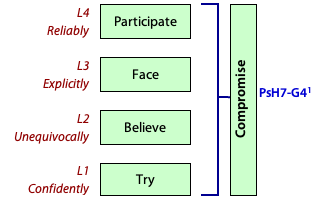
L1: because the compromise must permit decisions and actions in which all parties have confidence.
L2: , which is about holding to certain principles and fundamentals. There can be no "give" here: an arrangement in which principles are abandoned is a surrender, not a compromise. So, for example, there can be no compromise with corruption.
L3: the actual reality that is causing a dispute and the specific concerns (i.e. values) of all parties whose differences threaten to disrupt proceeding and throw the relationship off-balance.
L4: , which is about the parties feeling and being permanently connected and dependent on each other as they discuss and negotiate.
Unnecessary Levels:
is not an issue because when compromise is necessary, it is unavoidable.
does not occur because dialogue focuses on what is known.
is not required: fortunately, because there is usually a degree of distrust in negotiations.
Inhibition: Any demand for held unequivocally-g2 to be abandoned will make compromise impossible to reach. If is not reliable-g4 because one side can walk away easily, then compromising may get broken off.
Many other factors can prevent compromise including pride, rigidity, fears of a slippery slope, wishes to dominate, and over-attachment to negotiable options.
Threat: The social threat is reaching a deadlock, in which neither party will give in. The personal threat is being dominated when it comes decision-making.
Common Criticisms: Compromise is often portrayed as weakness. It is only betrayal if principles are abandoned.
Oppose-G42
Function: To maintain the integrity of a relationship through genuine disagreement.
Opposition is about acknowledging differences, typically by revealing what you know or think and getting that view recognized by others who you know may well disagree.
«If everyone is thinking alike, then somebody isn't thinking.» Gen. Patton
If a group values honest expression rather than submission, then bringing differences out into the open is the best policy. Opposition preserves a relationship by allowing a vitalizing tension, and minimizing groupthink via conformity or one-sided dominance.
Balance is progressively lost if necessary opposition is avoided for the sake of peace, compliance or approval.
Structure: is therefore based in:
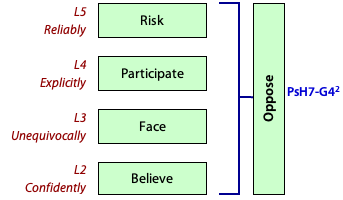
L2: that your position has merit and revealing it is constructive, because opposing makes no sense if this confidence is lacking.
L3: a particular reality or relevant principle and refusing to distort, ignore or pretend to be blind to it.
L4: by making it clear that your concern is a concern of the group and so all parties must pay attention to the issue.
L5: your reputation and respect within the group:
Unnecessary Levels:
is not an issue because opposing is about ideas and positions.
is not required.
is irrelevant when articulating differences.
Inhibition: While should be reliable-g4, fears of disapproval or rejection may till be present; and while reality must be unequivocally-g2, self-doubt can activate urges to conform and minimize disruption.
Threat: The social threat is generation of discord, with intense emotion and potentially turmoil. The personal threat is about dominating or being dominated.
Common Criticisms: Opposition is often portrayed as being difficult, obstructive or even destructive.
Collaborate-G43
Function: To work jointly with others through pooling of knowledge, resources and effort.
Collaboration is based on recognizing that no one person or group has all the knowledge, skills and resources that are required for a particular project. The effect of collaborating is to integrate diverse perspective and allow ideas to evolve and improve through shaping by multiple minds. The result is that participants learn from each other, and can test what is learned through application.
Structure: is therefore based in:
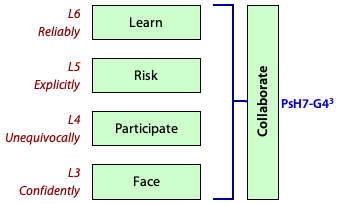
L3: a project because of the pooling of resources and integration of effort. Without confidence in the enterprise, collaboration will not arise as a possibility.
L4: , which is about being absolutely certain that a joint effort is required for the particular project.
L5: because risks can be distributed. However, there is always the possibility that one party may not pull their weight, withhold their strengths, or take advantage of the other.
L6: , which is required to benefit maximally from the other party's contributions.
Unncessary Levels:
is not intrinsic because the work or project is pre-determined, agreed and in process.
is superfluous and might even keep a pointless project alive.
is open-ended while collaboration is focused on a project.
Inhibition: must be unequivocal-g2 and so any antipathy will interfere with effective collaboration. Possessiveness or controlling tendencies can interfere with reliable-g4 .
Threat: The social threat is a distancing or withholding in the joint work. The personal threat is secretiveness.
Common Criticisms: Collaboration is often viewed as slow and inefficient, but that depends on how it is organized. It can also be viewed as foolish or naive because it leads to a transfer of knowledge or skills.
Unite-G44
Function: To bond with diverse others through offering sincere dependability.
Bonding means a degree of merging of identities. The result is that a communal spirit is evoked. This enhances rapport and enables solidarity. Investigations have proposed that a worthwhile communal existence is developed by uniting with others, and implies caring about others.
However, this is at the cost of full independence, and the activation of unity calls for a degree of humility.
While other preservers of relationships tend to be episodic or time-limited, unity is typically envisaged as enduring.
Structure: is therefore based in:
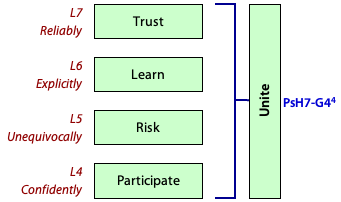
L4: because the existence of a group and your membership is taken for granted. Without confidence, uniting will not emerge as a possibility.
L5: personal freedom .
L6: about the other party and how the bond will actually function in practice.
L7: , which means there is an assumption that the quality of the relationship will resist doubts, suspicions and other damaging negative attitudes.
Missing Levels:
is not an issue because there is no activity or performance implied by uniting.
is not an issue as a diversity of beliefs is to be expected.
facts or reality is not required because uniting is not a situational matter or determined by facts.
Inhibition: If is not unequivocal-g2, there may be a holding back due to fearing demands or exploitation. If is not reliable-g4 because it is being poisoned by doubt or suspicion, then unity will be superficial.
Threat: The social threat is the emergence of a deep split or division that seems unbridgeable. A personal threat to unity comes from arrogance.
Common Criticisms: Uniting is views as unrealistic or idealistic.
Reflections
and , the odd tetrads, have practical or external inhibitors of effectiveness. and , the even tetrads, have inner personal inhibitors, like fear and doubt, of effectiveness.
is a feature of all four tetrads:
reliable for , because there can be no walking away
explicit when , because it must be clear you are an insider assisting the group and not an outsider blocking it.
unequivocalwhen , because withdrawal secretly or overtly must be avoided or prohibited.
confident when , because bonding takes it for granted.
See Tabulation for Easier Comparison
Psychosocial Pressures
Studies in the Architecture Room have determined a standard pattern for pressures in the groupings of structural hierarchies. These studies determined what are now called 1° structural or identity pressures.
The identified 1° structural pressure for G4 is certainty.This applies here because the person can be expected to experience a pressure to adhere to and deliver on those intentions.
More recent studies in a structural hierarchy identified the presence of a 2° operating pressure by focusing on the groups within any grouping. The pressure driving use of the various G4-groups here——should be acceptability if it follows the standard pattern.
On reflection, that could fit because a person is unlikely to use or be allowed to use these if they are not acceptable both to the person and to the others involved.
Transition
The relationships will have been preserved and balance maintained, but rendering assistance calls for the generation of outcomes that are experienced as assistance.
The possibility of going astray is your responsibility and not so much the concern of recipients. A way to proceed must therefore be found to deal with diverse emerging difficulties, uncertainties, blocks and diversions.
It is possible to by adding an additional adjacent level to form pentads that specify —if the willingness is there.
-
The 3 generators of outcomes: G5-Pentads.
Originally posted: 20-May-2026.