Generation of Centres
The Tension
The goal here is to appreciate the dynamics of in the world-as-it-is. That means recognizing the tension that immediately arises in situations where we must choose whether or not to respond.
As well as personal intentions and interests, it is essential to deal with practical pressures and social constraints that are likely to affect responding. These are modeled using a dynamic duality, which states that functioning of any grouping/level may be governed in three distinct ways:
- personal or individual perspectives and forces, essentially self-based, labeled P.
- social or milieu perspectives and forces, essentially impersonal,
labeled S.
- a synthesis or fusion of personal and social that cannot be disentangled—leading to a balance and labeled B.
Application of a dynamic duality to any Level converts it either into one balanced Centre or two polarized Centres. When there are two centres, as a matter of convention, the more dominant one in practice is placed on the right side of the Tree.
Names used for the G-Requirements may need to change in a Centre due to the effect of the duality and by practical realities that come into play in Tree frameworks.
Applying the Duality
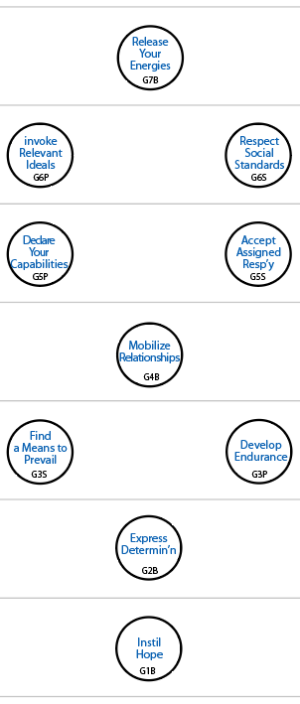
G1/L1:
is a single balanced Centre:  Why?
Why?
G2/L2:
is a single balanced Centre: Why?
G3/L3:
is polarized with two different Centres named:
Dominance: The two Centres naturally affect each other, but endurance () must persist and continue whether or not you find means to prevail () and regardless of the outcome. So developing endurance is dominant and placed on the right in the Tree.
G4/L4:
is a single balanced Centre: Why?
G5/L5:
is polarized with two different Centres named:
Dominance: The social situation is one where any assigned responsibility () is public and generates expectations. Acceptance must take preference over declaring capabilities () that you might prefer to use but which others may have less interest in. So is dominant and placed on the right in the Tree.
G6/L6:
is polarized with two different Centres named:
Dominance: The communal verdict governs whether invoked ideals () are appropriate and count in regard to social acceptability and excellence. Your choice of values cannot alter social standards. So respecting standards () is dominant and placed on the right in the Tree.
G7/L7:
is a single balanced Centre: Why?
- Step-1: Anchor responsiveness by creating a base.