Painful Disengagement
A Continuous Presence
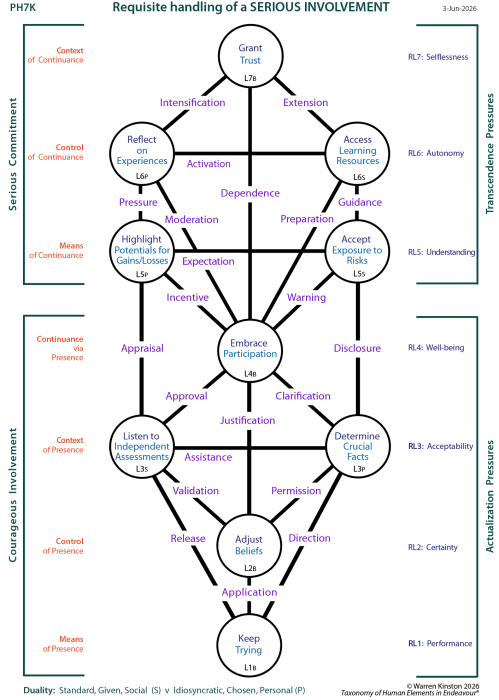
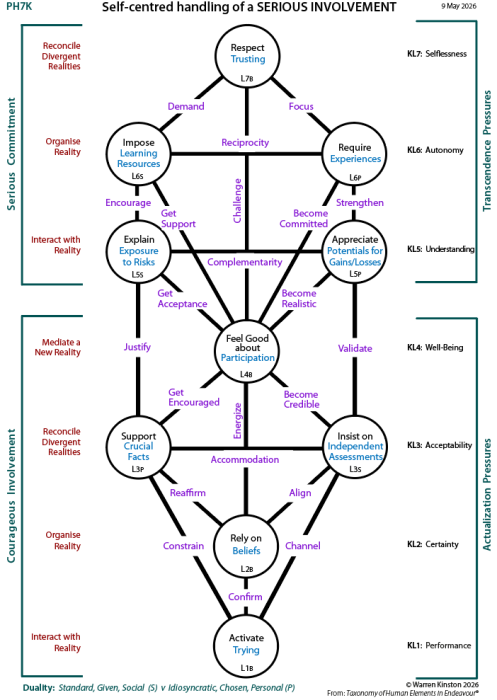
Any develops over time. Its framework reveals the importance of continuance as intrinsic to commitment, which is the upper pole of the internal duality (Ls 5-7). Presence manifests your seriousness, which is the lower pole of the internal duality (Ls 1-4).
The diagrams below allow comparison of the full picture of the requisite and self-centred Tree patterns.
Better viewing: Widen browser window and use browser zoom if needed.
|
|
How Disengagement Develops
At any point, during the development of involvement, the states (Centres) can become unsupportive. Once that occurs a process of disengagement commences. The more serious the involvement has become, the more painful the disengagement.
Sources of disengagement will most likely be personally-controlled Centres.
At , you may become aware of crucial facts that are disturbing, even while independent assessments are reassuring. If independent assessments turn negative then you will be forced to look carefully at what is happening.
At , even if your acceptance of risk is unchanged, you start seeing the potential for losses as more likely than the potential for gains—possibly based on independent assessments.
At , your reflections on recent experiences start suggesting that matters are taking a turn for the worse and there is little you can do to remedy the deterioration. Learning resources are usually little help because they are conservative, look to the past and never focus precisely on your needs.
These 3 Centres feed into . Continued participation is not approved when disturbing facts emerge. Your incentive to participate is weakened by the seemingly increased likelihood of loss. As your enthusiasm moderates, you start feeling bad about participating, however nobly intentioned you may be.
While you are mentally disengaging you may still and , although that becomes harder to justify.
The pain associated with disengaging is probably related to feeling let down as diminishes or in the extreme vanishes.
-
Get involved or not? Review the dating dilemma.
-
Back to the Review.
Originally posted: 6-Jun-2026.