Get Oriented to Rendering Assistance
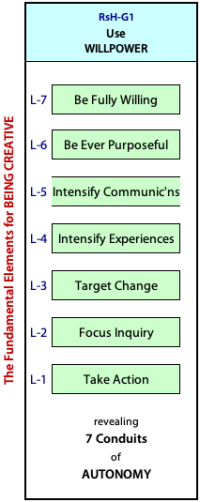
Willingness to Rise to a Challenge
In looking at creativity in endeavours (), it was proposed that it emerged as part of an urge to rise to a challenge and depended on willpower.
The critical levels were the transcendence levels: it was not enough to , communications needed to be intensified, not enough to have a , your purposes needed to be always kept in mind, it was not enough to , you had to be fully willing. Willingness-L7 combined with values-L6 is what makes all the difference between activity that is perfunctory and activity that is likely to be personally meaningful and socially significant.
In this investigation of the willingness domain, it will be necessary to clarify exactly what «» entails and how it appears apart from its use in creative endeavours.
The first implication is that all 7 levels of willingness will need to be activated—anything less would be incomplete by definition—and this use of all 7 levels generates a serious involvement.
Serious involvements that are selfless involve for the benefit of others, which is always a challenge.
Remember: The focus here is not on any particular endeavour associated with that assistance, it is on the psychosocial functioning that supports activation and pursuit of helpful endeavours.
Being Fully Willing to Assist
As developed earlier, the elements of willingness are rather ordinary psychosocial functions that become specialized by a fully conscious awareness that things may not go well and that continuance will be stressful or problematic.
Every activation of a willingness element therefore can bring with it a silent or articulated hope that the undesired and frustrating factors will not dominate and dissipate the effort.
Will that hope be realized? It is impossible to know. It just has to be activated as a matter of faith. This means that each level of willingness becomes a , and assisting selflessly becomes an act of faith.
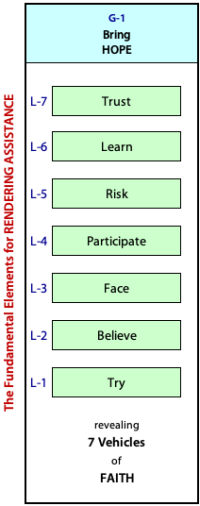
, by itself, is not a strategy. Nor is . Hope and faith often appear to be no more than wishful expectations that reveal and indulge passivity. Hope that is generated by the activation of willingness is not a strategy either, but it is far from passive: it is an active initial step required to make a meaningful difference in a challenging situation.
To strengthen the effects of each level of willingness and put substance on the bare bones of hope and faith, the levels can be combined. Combinations can be expected to illuminate all the complex willingness forms that may need to be activated to ensure that assistance can be rendered.
In THEE, combinations are found in structural hierarchies.
Full Willingness as a Structural Hierarchy
Each Level in such a hierarchy is a Grouping and contains all Levels of the originating hierarchy, here the . Each Grouping contains Groups that are the components with distinctive functions that may be activated when required.
 Technical Details: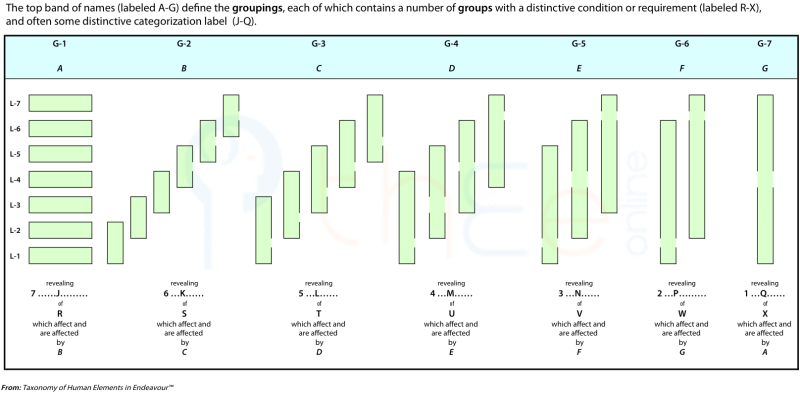
Before developing the , grouping by grouping in the structural hierarchy, an overview of the whole picture can help in getting oriented.
OR
- Start with the end result.
Originally posted: 20-May-2026