Reveal Intentions: CG3
 The Story So Far
By plausibly you energize 7 …
…which establish the foundation of future compatibility within a created relationship.
In coherently, you energize 6 …
…which apply in social settings so as to provide a basis for connecting.
…now read on:
Deepen Interactions
An early requirement in any social relationship is to know the other party's intentions. You can ask directly, of course, but the answer you get may not be completely truthful. Asking also ignores the other party's concern for your intentions. Again, expressing these directly is not straightforward and often impolite, partly because, as the saying goes, God gave man a tongue to hide his thoughts. In addition, it can be quite difficult to know exactly what is important to you.
«» here cover not only immediate goals, but also values, beliefs, ideals and long-term aspirations. These will become apparent when you are sufficiently engaged to have longer conversations and actually address situations together.
Triad Function: To interact more intensely so as to enliven a relationship.
Generating, developing and maintaining a relationship is rarely completely straightforward. However, whatever the course of events, compatibility becomes progressively clearer and more meaningful over time.
The first step is to intensify interactions where you put yourself on the line in social terms. The emotional component of a relationship is important and may feel overwhelming, but it remains secondary when compatibility is the concern.
Mechanism: Deepening develops through interplay between the parties. Intentions are revealed and engagement facilitated through conversations, actions that speak louder than words and events of all sorts.
Personal Strength: Interplay calls for attunement to the other party as well as to your own state. Note that attunement is the core stabilizer for , enabling mutuality and recognition of the needs and qualities of the other party. As such it is crucial for deepening an engagement.
Qualifier
Given that relevant to another party is the way to present yourself socially, it is necessary to determine a qualifier for these : see an explanation here. This g3-qualifier will need to characterise the third level in every group in this and all subsequent groupings.
Qualifiers get their character from the correspondingly numbered monad, which for g3 is . Because interpretations are always speculative and may offend, the qualifier is provisionally proposed as «respectful». Anything respectful is provided with due consideration for the likely differences in views and feelings of others.
Psychosocial Pressures
The expected 1° pressure is performance. This fits here given that a social task is operative. Your goal is to develop an engagement that allows you to reveal your intentions, discover the intentions of the other party and start a working relationship.
The expected 2° pressure is certainty. This also fits because shared intentions are a source of stability and, if mismatched, a source of anxiety. The more uncertainty that is allowed to emerge when seeking to engage, the weaker the sense of engagement and the more fragile any bond.
Methods of Engagement
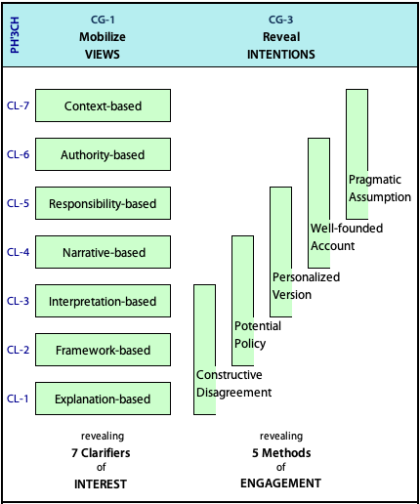
provides a basis for , which is enabled by combining three adjacent levels of to form triads. These intentions reveal .
The are named as follows:
In each triadic engagement:
- the g3-upper level determines a critical quality of the engagement and must be respectful so as to avoid offence.
- the g2-middle level must be coherent to ensure the engagement process makes sense.
-
the g1-lower level must be plausible to provide credible and confident grounds for engagement.
How It Goes Wrong
Everyone engages when seriously seeking to clarify compatibility with a counter-party. But engaging can fail to reveal intentions, both yours and theirs, and then it subverts the very fit that it should be seeking to check.
It goes wrong…
…if you are driven to dominate, control or win in your interactions:
e.g. disagreement becomes combat, perceptions are imposed dogmatically.
…if you do not respect the nature of the situation:
e.g. you twist the facts or make unwarranted assumptions.
The effect of such behaviour is that your engagement becomes a performance aimed at an outcome rather than serving as an opportunity to reveal your values and goals and discover those of the counter-party.
Of course dialogue and interplay do not just depend on you. If the other party is unwilling to participate, then interactions will become superficial or artificial and perfunctory. Mutuality cannot develop in this case, attractiveness will weaken, and any suggestion of compatibility will be short-circuited.
- Differentiate the CG3-methods of engagement via functions, structures and concerns.
Originally posted: 6-Oct-2026.