Assess Fit: CG4
 The Story So Far
By plausibly you energize 7 …
…which establish the foundation of future compatibility within a created relationship.
In coherently, you energize 6 …
…which apply in social settings so as to provide a basis for connecting.
In respectfully, you energize 5 …
…which establish a working relationship with the potential for compatibility.
…now read on:
Make it Real
Before making any commitment, it is necessary to work out if there is a fit in the relationship. Such assessments involve imaginative part-formulated judgements that typically emerge spontaneously. Over time they lead to a recognition of how the relationship is working for you, which may not necessarily be welcome. Dialogue with a trusted friend or therapist may lead to insights into your experiences of both effective meshing and jarring interactions.
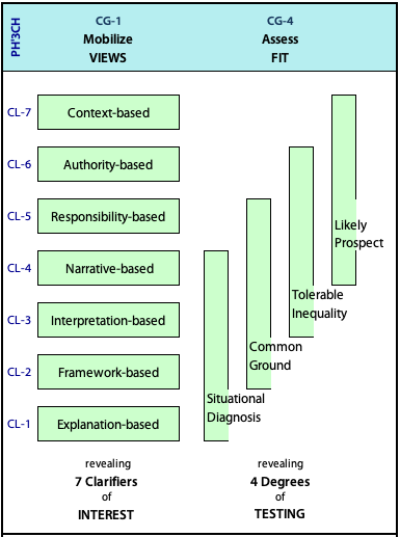
The essential criteria for a relationship of any variety are whether it is meaningful, whether there is an affinity, whether it is safe, and whether it will continue. These generate progressively demanding tests whose failure can rule out compatibility.
Tetrad Function: To judge whether there is sufficient compatibility to make furthering the relationship worthwhile.
is not a singular event but a continuing requirement. All four tetrads contain a component. As time passes and events cumulate, narrative-based views are liable to change and that potentially alters assessment.
Mechanism: Assessment of fit calls for confrontation of the present reality. You must be willing to see things as they are. This does not mean confronting the other party, but discussions with family or friends about whether the relationship fits you, can only be constructive if you are open and candid.
Personal Strength: Confrontation requires dispassion. Neither your wishes nor pressures from others have any relevance to whether or not a fit exists. You need to summon the willingness to look impartially and disinterestedly at both facts and feelings in order to come to a judgement about the quality of your fit.
Qualifier
Given that is a requirement for clarifying compatibility, it is necessary to determine a qualifier: see an explanation here. This g4-qualifier will need to characterise the fourth level in every group in this and all subsequent groupings.
Qualifiers get their character from the correspondingly numbered monad, which for g4 is a . Narratives always present themselves as reality-based, even if those behind them are fully aware they are not. So the qualifier is provisionally proposed as «realistic». Anything realistic is reached on sufficient grounds for treating the conclusion as sound and believable.
Psychosocial Pressures
The expected 1° pressure is certainty. This fits here given that this is the crucial mediating grouping: if the assessment is positive then you commence entry to the relationship, if negative, then you withdraw. A drive for certainty accords with the importance of assessing correctly.
The expected 2° pressure is acceptability. This also fits because there is no absolute diagnosis of a relationship, no proper common ground, no universal definition of tolerability in regard to inequality, no guarantee of prospects. Whatever your assessment throws up has to be acceptable or the fit is simply not there.
Degrees of Testing
leads to a depth of engagement which permits within the relationship. This is enabled by combining four adjacent levels of to form tetrads which reveal .
The are named as follows:
Note that all the tetrads possess a : initially realistic within a , then respectful to form a , then coherent in regard to , and finally plausible when predicting the future.
In each tetradic test:
- the g4-level is realistic, which has to be critical when assessing fit;
- the g3-level is respectful to ensure assessment is deep while avoiding offence;
- the g2-level is coherent to ensure the account of fit makes sense;
-
the g1-level is plausible to provide assessments with a credible foundation.
How It Goes Wrong
Everyone assesses fit within their relationships, especially in the early stages. When it comes to fit, it is what it is—so fit must be determined in a balanced and dispassionate way, letting the chips fall as they may.
When there are difficulties, and in relationships there are always difficult issues, confronting reality is not easy.
If assessments of fit are dominated by your hope or neediness, you will want the relationship to work. So your diagnosis may be too favourable, the common ground may be exaggerated, inequality will be ignored rather than addressed, and the likely prospect will be a fantasied wish-fulfilment because anything else seems unbearable.
If assessments of fit are dominated by fear, self-sufficiency or cynicism, then the diagnosis will be too harsh and a genuine bond will be distrusted, the common ground will be dismissed or devalued, inequalities will be over-emphasized, and the likely prospect will be one of doom or futility.
- Differentiate the CG4-degrees of testing via functions, structures and concerns.
Originally posted: 6-Oct-2026.