Resolve Conflict: CG7
 The Story So Far
By plausibly you energize 7 …
…which establish the foundation of future compatibility within a created relationship.
In coherently, you energize 6 …
…which apply in social settings so as to provide a basis for connecting.
In respectfully, you energize 5 …
…which establish a working relationship with the potential for compatibility.
In realistically, you energize 4 …
…which apply a variety of criteria to determine the relation's sustainability.
In responsibly, you energize 3 …
…which establish the possibility of genuine enduring compatibility if functioning together is satisfactory.
In properly, you energize 2 …
…which apply the hopes of belonging to daily exigencies as a member of a relationship-unit.
…now read on:
Evolve in Good Faith
Because a social identity, like any identity, resists modification, the need for change cannot be absorbed quietly. Instead, pressure from disagreements builds until it appears (or erupts) as conflict.
Conflict threatens the continuance of the relationship. Compatibility appears to have been lost. It then becomes necessary to face your own priorities. Is the relationship important enough to be preserved? If it is, then it will have to evolve and you will have to enable that by highlighting the presence of a conflict and actively seeking a resolution.
Heptad Function: To restore and protect compatibility in a mutually satisfactory manner.
If confirms your place and fit within the relationship, then adding an adjacent level forms a heptad which deals with . The heptad is 1 , which is named:
Such a resolution that suits and benefits all involved can restore harmony to the relationship. It is only possible through good faith negotiation in which relevant issues and interests are brought out into the open so that a mutually satisfactory agreement can be reached.
So: Function: To reach a beneficial settlement freely owned by all parties.
If and when that is achieved, the relationship's identity adjusts and compatibility is re-affirmed even more strongly than before.
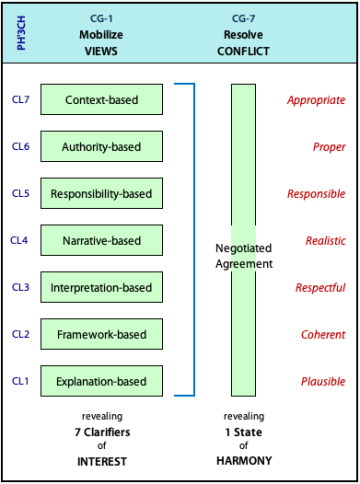
Mechanism: Noticing an emerging conflict is a matter of sensitivity, while taking action on the conflict calls for responsiveness. Conflict is often suppressed or even denied, but that does not make it go away. Conflict gnaws away at comfort and cooperation, and only by responding to it can a remedy emerge in the form of a .
Personal Strength: Responsiveness and negotiations call for attunement, which (as noted in CG3) is the core stabilizer of . The challenge is to reach an agreement in a way that does not embarrass you or spoil the cooperative spirit. Attunement ensures that matters like timing, presentation, and rebuttal of unworkable suggestions are carried out in a sympathetic way.
Qualifier
Because is required to clarify compatibility, it is necessary to determine a qualifier: see an explanation here. This g7-qualifier only needs to characterise the seventh level in this final heptadic group.
Qualifiers get their character from the correspondingly numbered monad, which for g7 is a . So the qualifier is provisionally proposed as «appropriate». Anything deemed appropriate is generated in a way that suits the particular situation while supporting the value of the relationship.
The Structure of Harmony
For compatibility purposes, the ) must be:
— appropriate given the as shared by the parties;
— proper in terms of the as agreed by all;
— responsibly handled given your for resolving the conflict;
— realistic in the light of a shared ;
— respectful in taking account of differing of the issue;
— coherent as a for the relationship going forward;
— plausible in its and other relevant statements.
To achieve this result, negotiations need to be conducted in good faith, which conventionally demands honesty (cf. g3, g5, g6), transparency (cf. g1, g4), and genuine intent (cf. g2). Correct handling builds trust and maintains long-term relationships, whether personal or commercial.
Psychosocial Pressures
The expected 1° pressure is selflessness. This fits here because determination to resolve conflict requires the relationship to be given primacy over personal wishes and concerns. A result must be sought that is perceived by the other party to be beneficial for them.
The expected 2° pressure is autonomy. This also fits because in pursuing negotiations it is essential to know your own position and stand up for yourself. The final agreement that is reached must be one that you can own and feel is worthwhile. (Note that this is the same pressure that drives the identification and mobilization of your .)
The combination, while seemingly opposed, appears essential: selflessness alone could lead to capitulation or self-sacrifice, while autonomy alone could lead to disconnection and loss of a valuable relationship.
How It Goes Wrong
If negotiation is approached on a win-lose basis or dominating and controlling attitudes characterize the negotiation, then violations of one or more levels in the heptad will occur.
Conflict will not get resolved if either party holds to a particular core value that genuinely outranks the relationship. The relationship then hits its limit in compatibility terms and stalls or breaks depending on the intensity and significance of the conflict.
Transition
The highest degree of compatibility, it appears, is one where any temporary loss or disruption can be repaired through a foundation provided by valuing the relationship and your fit within it.
With this 7th grouping, all aspects required to clarify compatibility in a social relationship appear to have been identified, including enabling its acceptable evolution.
So reaching a enables and limits the , which returns the analysis to the monads-CG1.
Formulation of the many components of this structural hierarchy is now complete. The framework can now be reviewed and further investigated as a whole.
- Review the framework for clarifying social compatibility.
Originally posted: 30-Sep-2026.