4 Degrees of Testing
Orientation
Compatibility is not about identity between two parties, which is impossible, but about the emergence of a relationship-fit that permits living and working comfortably in the presence of individual differences.
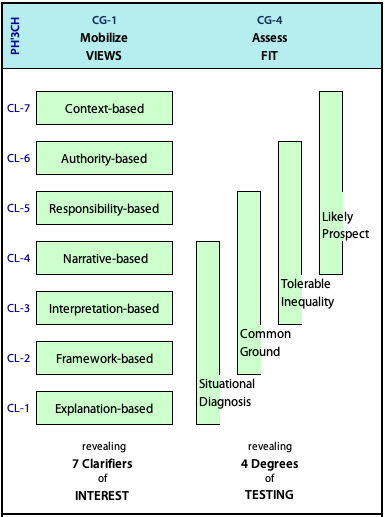
The first step is to clarify whether or not a relationship is viable at all, and this calls for employing tests to determine the presence of •meaning, •worth, •safety and •continuity in the relationship as it currently functions.
Remember: The function of is to judge whether there is sufficient compatibility to make furthering the relationship worthwhile.
The difficulty in testing is that powerful inner urges, wishes and fears, distort or disrupt sensible assessment. For relationships to work, denial of relevant realities must be recognized and overcome.
CG41: Situational Diagnosis
Focus: Bonding.
There must be a bond for any relation to be meaningful and invite compatibility. That bond must be vitalized and emotionally significant. If the relationship is purely transactional or contractual, it does not matter who the other party is as long as the deal is done. If no personal relationship actually exists, then compatibility is irrelevant.
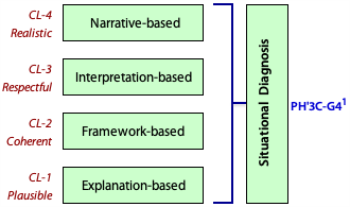
Function: To be explicit about the state of the relationship.
Structure:
The primary assessment of any relationship is a diagnosis of its current state. To enable this the element must be realistic. The diagnosis must also include a plausible of current interactions and be based on a recognizable or typology of relationships to make the diagnosis coherent: e.g. is it sociable, companionable, charitable, intimate, businesslike, criminal or abusive. Finally, the diagnosis must respectfully look beneath superficialities and public behaviours to underlying feelings, motives, doubts and fears.
Denial:
Refusing to be explicit and regarding vagueness as useful.
Taking the bond for granted, especially if feelings seem lacking.
CG42: Common Ground
Focus: Affinity.
Given the presence of an emotional bond, there is an issue of whether you and the other party are actually drawn to each other. When values and outlooks are shared, then there can be a commonality that goes to the heart of social functioning.
The bond makes the relationship meaningful, and now affinity makes the relationship worthwhile.
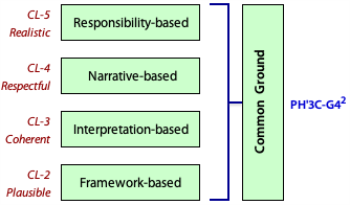
Function: To confirm sufficient sharing of values and outlooks.
Structure:
Common ground requires you to be realistic about your own values and outlooks which are your guiding light and remain your . The common ground must be articulated respectfully as a to handle inevitable small differences of view and other sensitivities that are invariably present. Any of the situation or the position of others needs to be coherently integrated. Finally, used in describing the common ground must be plausible.
Denial:
Claiming similarity that is stretched or wishful.
Mimicking or simulating enthusiasms to win interest and acceptance.
CG43: Tolerable Inequality
Focus: Power.
Although a relationship may be meaningful and worthwhile, there can be inequalities in factors like intelligence, money or status that imply a power discrepancy. For a good fit, there should be neither excessive deference nor attitudes of superiority. Inequalities need not matter if sensibly handled, but they can generate stress and, at the extreme, affect a necessary sense of safety.
So is what you share, and is the disparity you can live with.
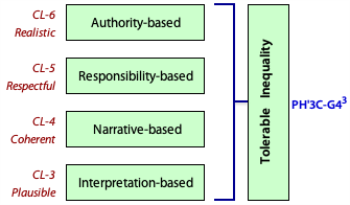
Function: To adapt to differences in power without undue stress.
Structure:
The presence of a power inequality is established through a coherent . Some factors in that narrative depend on plausible of personalities and events. Tolerating inequality starts from a realistic view of the of the attributes of both parties, because this limits coercion and exploitation. Given that legitimacy, you have a to respect differences and enable adaptations.
Denial:
Claiming an equality that cannot exist in practice.
Denying that a power imbalance matters.
Tolerating the intolerable.
CG44: Likely Prospect
Focus: Change
If the future is a concern, then the relationship currently exists as sufficiently meaningful (given the bond), worthwhile (given the affinity) and safe (given the inequality). But will this condition persist? Organisations change. People and their aspirations change. Circumstances and external demands change. Initial differences, for example in hobbies or goals, may lead to divergent life paths so that the parties end up growing apart.
So the final important test is an assessment of the continuity of a relationship.
Function: To consider how the fit may fare over time.
Structure:
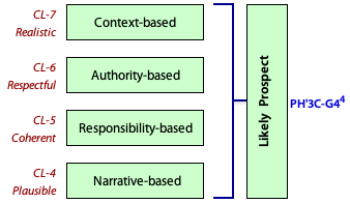
The potentially includes everything that surrounds the relationship including the nature of the parties. Because not everything will be relevant, being realistic and imaginative can be challenging. Although the future is unknown, a plausible must be developed and made coherent in terms of your values and outlook. Finally, distortion by hope and fear can be limited by respect for the provided by precedents, track records and experience, your own and others that you trust.
Denial:
Just assuming continuity.
Imagining something that will never be.
 Is Such Complexity Necessary?
To assess the fit in a relationship, it seems that there are 16 different confrontations divided into 4 groups of 4. It might be argued that nobody thinks about their relationships like this in real life. Mostly people develop an impression and work from that. So is the present complicated analysis really necessary?
That argument has some limited validity, especially if everything is going smoothly. However, is there any doubt about the importance of the 4 testing queries: what is going on in this relationship? how much do you have in common? is the relationship safe? and what are its likely prospects? These criteria are worth thinking about, and knowing the underlying structure can aid reflection.
In practice, a person clarifying common ground, for example, does this in a fused compressed mental process that is mostly implicit and below awareness. The taxonomic framework makes this tacit process explicit, and that may be useful, especially when something is going wrong. When there is misunderstanding and mishandling, it becomes necessary to disentangle the specific views of the relationship causing confusion.
Summary Table
| CG4 | Testing | Function | Focus of Concern |
Cumulation | Denial |
|---|---|---|---|---|---|
| 4 | Likely Prospect |
To consider how the fit may fare over time. | Change Can it last? |
Continuity assumes worth, meaningfulness and safety. | Just assuming continuity. Fantasy-based imaginings. |
| 3 | Tolerable Inequality | To adapt to differences in power without undue stress. | Power Is it safe? |
Assumes worth and meaningfulness. | Claiming equality as a right. Denying power matters. |
| 2 | Common Ground | To confirm sufficient sharing of values and outlooks. | Affinity Is it worthwhile? |
Assumes meaningfulness. | Claiming similarity. Mimicking interests. |
| 1 | Situational Diagnosis | To be explicit about the state of the relationship. | Bonding Is it meaningful? |
Clarifies the existence of a relationship. | Being vague. Taking a bond for granted. |
Transition
The clarification of social compatibility has reached the point at which confirm that have led to the formation of a viable relationship—viable in the sense of being meaningful, worthwhile, safe and potentially lasting.
Once a relationship has been tested in this way and a fit has been confirmed, it becomes possible to focus more directly on compatibility. The minimum need for a compatible relationship is explicit ownership. You must regard the relation as yours and feel that you truly belong there.
like this implies that you can identify fully with the relationship, and this can be checked by adding a fifth level to form G5-pentads.
- Continue to Check Identification (CG5-Pentads).
Originally posted: 6-Oct-2026.