Promises of Continuity: G2-Dyads
"If you can meet with Triumph and Disaster
And treat those two impostors just the same."
"If", Rudyard Kipling
Express Determination
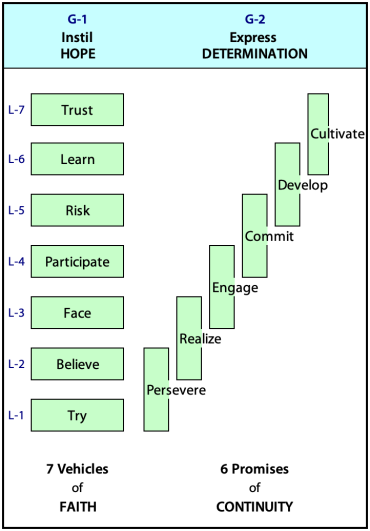
Generating when things are difficult is encouraging, but it almost immediately leads to a concern that these efforts are just a blip. Everyone experiences a need for ongoing active positivity. They seek reassurance from pledges to persist through to ultimate success no matter how difficult the course.
That can be handled through to proceed and optimistically promising that there will be continuity—even though it is impossible to guarantee the future.
This function appears to be enabled by combining adjacent levels to form 6 dyads.
Dyads require a qualifier which should fit with , and this is provisionally proposed as «unequivocal». Unequivocal means being unambiguous, unconditional and without displaying inner doubts or qualifications. In any dyad, the higher level (g2) offers an unequivocal quality to bolster the g1-confidence of the lower level.
communicates a and that can be generated in 6 ways:
The function of expressing determination is proposed as: to establish for oneself and others that efforts will be sustained despite setbacks.
These 6 dyads reveal 3 different foci for determination:
-
In the lower 2 dyads, the focus is personal
i.e. based only on a person's strength—or weakness:
is volitional, while is cognitive. -
In the middle 2 dyads, the focus is inter-personal
i.e. involving others directly or indirectly—or withdrawing:
is relational, while is social. -
In the upper 2 dyads, the focus is intra-personal:
i.e. fostering growth—or rejecting inner evolution
is maturational, while is transcendental.
Requirements: All the promises involve binding yourself despite not knowing the consequences. As a result, they all call for courage and resolve.
Dysfunction shows up through equivocating or operating in a perfunctory way, which may appear as hesitation, vacillation, or dithering.
Destructiveness presents here as a betrayal that breaks faith and dashes the previously raised hopes.
 Schema for Exposition
Function—which is the basis for taxonomic identification.
Unpacking the dyad into a lower level base and an upper level force.
Focus of binding in the promise.
Inner requirement that anchors the determination.
What is at stake if the promise is broken.
Dysfunction indicators.
Consequence of absence when a promise is needed.
Promises of Continuity
Persevere-G21
Function in expressing determination: To provide continuing effort—despite difficulties and setbacks.
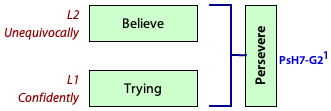
is constituted by with related to the effort.
Base is found in confidently trying. If there is a failure, then trying must occur with a different approach. There is no limit to the different tacks that may be taken because once a limit is hit, confidence goes and perseverance stops.
Force comes from application of relevant unshakeable beliefs, including that the effort is worthwhile and that a suitable path forward can be found one way or another. There are also likely to be specific beliefs relating to the issue and its context.
Realize-G22
Function in expressing determination: To become aware of a crucial aspect of a situation—despite the possibility of being wrong.
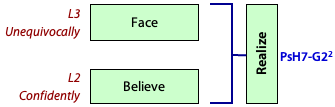
is constituted by and the situation.
Base is provided by confidence in beliefs that are directly relevant to the situation or related to the context or oneself.
Force comes from being resolute in cutting through superficial appearances, so as to know what is really going on. Becoming aware of all relevant aspects requires personal views and feelings like pain or embarrassment to be put to one side.
Engage-G23
Function in expressing determination: To become an intrinsic part of a social situation—despite possible uncongenial or detrimental events in the future.
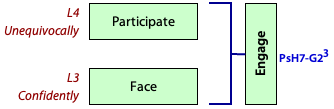
is constituted by the relevant reality and in the situation.
Base is provided by confidence in awareness of whatever is relevant in the situation, often a person or group but it could be an event or project.
Force comes from an irrevocable participation and social bonding in accord with conventions and situational requirements.
Commit-G24
Function in expressing determination: To bind oneself to a path into the future—despite uncertainty about the process or outcome.
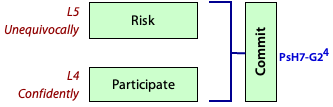
is constituted by and .
Base is found in confidently belonging to a group or social situation which anchors your identity and is affected by the promise.
Force comes from unequivocally wanting the benefit that is expected by becoming bound to a course in the face of known and unknown potential dangers.
Develop-G25
Function in expressing determination: To enable new possibilities to emerge—despite likely costs, missteps and failures in the process.
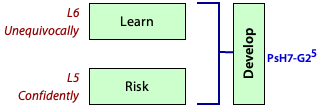
is constituted by and .
Base is provided by confidently putting energy and resources into experiments, new personal experiences and learning events with no certainty of benefits.
Force comes from an unstoppable drive to fill gaps in abilities by continually learning in different ways and reflecting constructively on whatever eventuates.
Cultivate-G26
Function in expressing determination: To nurture a relationship or capacity—despite temptations to abandon the quest.
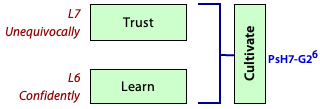
is constituted by and .
Base is provided by confidently absorbing knowledge and deepening understanding, usually under the tutelage of a master.
Force comes from a devoted dedication based on unequivocally trusting the other or a school and also the process.
Contrasts
Monads and Dyads
appears to involve assertion independently directed outwards to others who, it is assumed, will respond to the intrinsic positivity.
By contrast, the involves assertion directed inwards to oneself but dependent on confirmation from others that they respect the promise and are reassured.
Upper Three vs Lower Three
The binding requirement in the lower three is external/tangible
i.e. -Task/Resources, -Truth/Credibility, -Presence/Sincerity.
The binding requirement in the upper three is internal/transformative
i.e. -Destiny/Integrity, -Potential/Growth, -Betterment/Purity.
See Table Summary for Overview and Comparison
Psychosocial Pressures
Studies in the Architecture Room have determined a standard pattern for pressures in the groupings of structural hierarchies. These studies determined 1° pressures that are structural or identity-based.
The identified 1° pressure for G2 is understanding. This applies here because when , a person naturally seeks to fully grasp what is involved.
Recent studies in a structural hierarchy identified the presence of a 2° pressure related to operating groups within any grouping. The pressure driving use of the various G2-groups here——should be performance if it follows the standard pattern.
On reflection, that would fit because once you , you are expected to deliver on that promise. If you do not, then you will not only suffer socially but also psychologically because of what was at stake: your resources, your credibility, your sincerity, your integrity, your growth or your purity.
Transition
has been promised—but often, especially in difficult situations and even given intense determination, it is easy to lose focus.
The possibility of going astray is ever-present. Determination does not prevent emerging difficulties, delays, new uncertainties, setbacks, blocks and distracting diversions. Quite the contrary: you are forced to address most of these.
You are attempting the impossible after all, and (like Rome) it won't get done in a day. So, whatever emerges, you must seek to prevail and, whether or not you succeed, you must endure. You may not progress as you desire, but you must hold out and manage even in the most difficult circumstances.
is possible by adding an additional adjacent level to form triads which reveal 5 essential .
- Compare binding yourself through oaths and vows.
- The 5 means of prevailing: G3-Triads.
Originally posted: 12-Jun-2026