Forms of Drive: G5-Pentads
"To strive, to seek, to find, and not to yield"
"Ulysses" (1842) Alfred, Lord Tennyson.
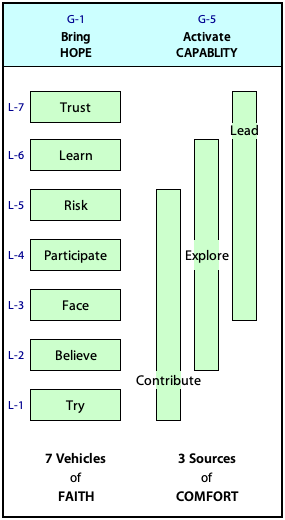
Declaring Capabilities
If are mobilized and is assured, you are in a suitable position to use and safely release to contribute constructively.
Drives may succeed or fail, and that is not under personal control. However, without drive nothing will happen. It follows that the two higher groupings, and , can be expected to guide personal drive and depend on personal capabilities.
include both your various personal abilities and also other resources that you can command: facilities, contacts, finances, equipment and more. These need to be acknowledged, activated and publicly declared to facilitate their deployment and potential integration with the efforts of others.
can be enabled by adding an additional adjacent level to form 3 pentads.
Each pentad has a new qualifier that needs to fit with . This is provisionally proposed as «reflective» in the sense of thinking deeply about a matter including personal awareness, opinions and conclusions.
This means that each pentad that results from must function reflectively and consist of g1-confident, g2-unequivocal, g3-explicit, g4-reliable and g5-reflective levels. The labeling of the pentads is as follows:
The function of declaring capabilities is proposed as: to take on a demanding responsibility that could change the situation.
Requirements: Authenticity and openness are needed to make any declaration, but this depends on self-scrutiny and self-knowledge. Once a capability is asserted, accountability must be accepted for its use.
The pentads are all demanding, but they reveal a progression moving upwards. At the base, the drive is relatively straightforward and can be minimal, while at the top the drive is socially complex and potentially highly significant.
Dysfunction is evidenced by avoidance which may show up as denial, evasiveness, or procrastination. A drive may get distorted or blocked due to external disruptions about which little can be done. Outsiders may spoil, sabotage or suppress a claimed capability out of competitiveness, envy, dislike of change, or a self-interest that disregards community needs.
Destructiveness shows up as blame-shifting that rejects taking responsibility and refuses accountability.
 Schema for Exposition
Function—which is the basis for taxonomic identification.
Mishandling
Internal structure of the pentads, including clarifying why absent levels are unnecessary.
Effect of Weakness of each of the internal levels.
Forms of Drive
Support-G51
Function: To provide a tangible or intangible input that seeks to assist.
As part of any impossible attempt, support is essential because it shares the load. It can take numerous forms: support for an emergent leader, support for group maintenance or morale, support in a fight, support for specific individuals who need it. Support in all cases involves a degree of personal interaction with recipients. If this goes well, the result is a welcome usefulness, but if it fails then the support is irrelevant.
Common conceptions of support are meagre: just giving money, agreeing with someone, listening to a complaint, or offering encouragement. This is why so much support in ordinary life is ineffective or experienced as hollow: see the effects of weakness in particular levels below.
Mishandling: Support that is misdirected, self-aggrandizing, imposed or forced.
Structure: is constituted by:
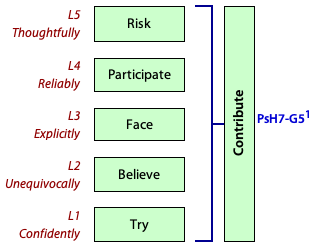
L1: , because while there is no certainty that the support will indeed assist, the approach must remain positive, and if one form of support does not help, then other forms can be offered.
L2: that support is needed, that the recipient deserves support and that the form of support has value.
L3: the situation and the needs so that the support can be explained and directly targeted.
L4: because support needs to be sustained and that means feeling or becoming part of the group.
L5: , because support may be counter-productive, may not be enough or may be rejected. The process and effects need to be observed, thought about and evaluated.
Unnecessary Levels :
Explore-G52
Function: To enter the unknown to obtain knowledge that may be useful.
Ignorance or blindness can easily prevent responding effectively to a challenge. Exploration is therefore a valuable option when a remedy for a painful or dangerous situation is not apparent. By inquiring so as to reveal and appreciate essential details, it may become possible to identify weaknesses and opportunities.
The desired effect of exploring is to obtain knowledge that can permit a breakthrough, while the risk is that it will produce nothing and lead to a sense of futility.
Mishandling: Exploration can be self-indulgent, wasteful of resources, or
impractical.
Structure: is constituted by:
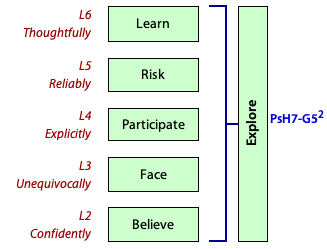
L2: that what is sought exists and can be discovered.
L3: the phenomenon to be explored and the resources actually available, because self-deception means failure.
L4: because the process benefits from the support of others, some of whom may need or wish to be actively involved. Also the findings may have group relevance and need group acceptance.
L5: , because there are numerous potential risks—physical, resource-based, reputational, opportunity costs—and these must be continuously appreciated and tolerated.
L6: , because that is necessary to commence, guide and evaluate exploration, as well as being the main goal of the process.
Unnecessary Levels :
Lead-G53
Function: To persuade others to follow a course for their own benefit.
Leadership involves convincing others to follow a course which is believed to be good for them and that will achieve something they desire, even if they may not be properly aware of this. The group coalesces around the leader's direction because the aim is to generate group success, even if the ultimate outcome turns out to be group failure.
The group is likely to follow, but that is not guaranteed. Natural leaders are more likely to be successful than other types because of the natural response of their followers.
Mishandling: Leading that is presumptuous, manipulative or too controlling is likely to generate a negative reaction from others and may fail to develop a significant following.
Structure: is constituted by:
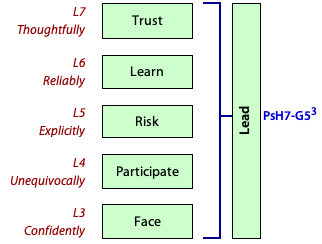
L3: the facts because the leader needs to see reality clearly and not flinch from recognizing obstacles and opposition if a viable direction is to be identified.
L4: , which is about being part of the group and the group perceiving the leader as representing them and concerned about their well-being and success.
L5: , because when setting a direction the leader must highlight potential gains, while revealing or implying dangers including the possibility of losses. Leaders publicly stake their judgement and, if they have miscalculated, a loss of reputation is likely.
L6: , because the leader must get into possession of necessary knowledge about the change, continue to learn as events unfold, listen to followers, and ensure that the inevitable mistakes become opportunities for learning.
L7: , because persuasiveness depends on the leader trusting that things will work out given the nature of the group, the situation, and processes as events evolve.
Unnecessary Levels :
See Table Summary for Easier Comparison
Level Characteristics
In examining the tetrads, it was possible to identify level characteristics as follows:
-
g1 provides for initiation and ensures a foundation.
-
g2 involves principles and ensures integrity.
-
g3 calls for contesting and ensures intensity.
-
g4 enables adaptability and ensures sustenance.
These formulations can be checked for the pentads: the reader is left to do this but the formulations are confirmed.
Now the nature of g5 must be formulated and here is a reminder of the findings from above:
In , g5 is , which is about accepting that support does not always help, and it is necessary to observe the process and effects to confirm whether the support is functioning as anticipated. If this is missing, support will not get assessed and altered.
In , g5 is , which is about checking that learning has indeed occurred as part of exploring as intended. If this is missing, exploration will misperceive what is encountered and fail to realize what knowledge is worth preserving.
In , g5 is , which is about ensuring the continuing appropriateness of trusting that things will work out given the nature of the group, the situation and evolving events. If this is missing, persuasiveness weakens and leading is likely to become over-controlling or hyper-anxious, which will alienate followers.
Conclusion:
-
g5 provides for evaluation and ensures judgements. In its absence, the group function is likely to suffer a breakdown.
Oscillating Pattern
The tetrads confirmed the presence of an oscillating pattern:
involves assertion directed outwards to the socio-physical milieu and operating independently.
involves assertion directed inwards to oneself but dependent on confirmation from others.
involves assertion directed outwards to the socio-physical milieu and operating independently.
involve assertion directed inwards to oneself but dependent on confirmation from others.
It therefore would be expected that:
will be a matter of assertion independently directed outwards, which appears to be the case. The drive to support, to explore and to lead all fit that description. So this form of oscillation is a definite characteristic of the framework.
Psychosocial Pressures
Studies in the Architecture Room have determined a standard pattern for pressures in the groupings of structural hierarchies. These studies determined 1° pressures that are structural or identity-based.
The identified 1° pressure for G5 is acceptability. This applies here because a person will only if it is acceptable personally and for others involved.
Recent studies in a structural hierarchy identified the presence of a 2° pressure related to operating groups within any grouping. The pressure driving use of the various G5-groups here——should be well-being if it follows the standard pattern.
On reflection, that could fit because there will be a strong desire to provide relief and comfort: for the support to assist in a gratifying way, for exploration to be useful and even enjoyable, and for leading to benefit followers in a way that is satisfying.
Transition
Drive finds its rationale in available capabilities, and the quality of those capabilities will be critical in shaping the evolution of the situation.
In considering quality, there are two separate but linked issues: the ideals that are intrinsic to the challenge that capabilities are addressing, and the degree of excellence when exercising any capability.
It turns out that it is possible to by adding an additional adjacent level to form hexads, and that reveals .
-
The 2 sources of excellence: G6-Hexads.
Originally posted: 12-Jun-2026.